
Mood is often treated as something separate from the body, as if emotions and mental states exist independently from physiology. Anxiety becomes categorized as excessive worry. Depression becomes categorized as sadness or low motivation.
But mood is not only psychological.
It is physiological interpretation.
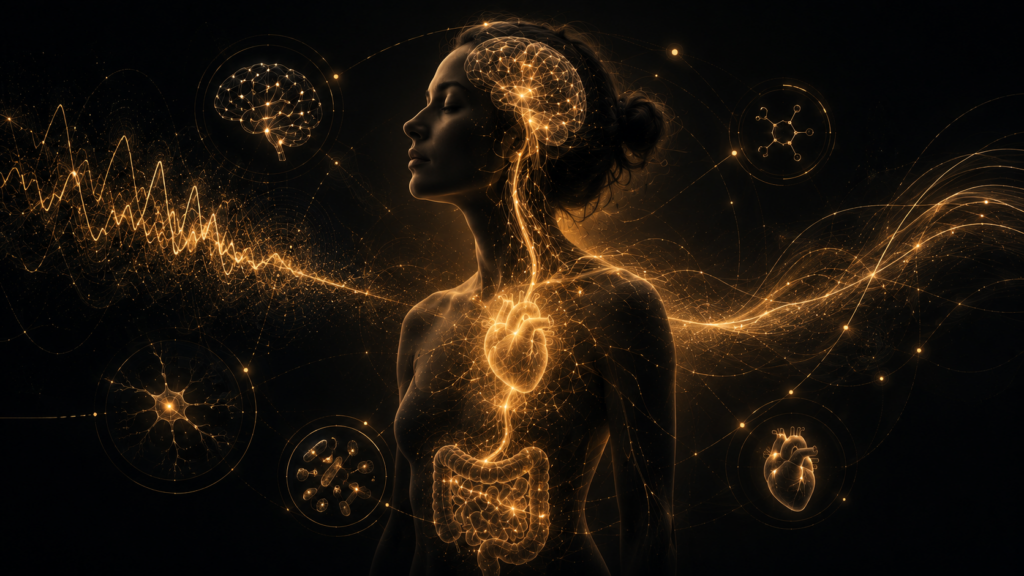
At the biological level, mood reflects how the nervous system, endocrine system, immune system, metabolic system, and brain are collectively assessing internal and external conditions.
This does not mean anxiety and depression are “all in the body” or reducible to biology alone. Human emotional experience is far more complex than chemistry. But physiology shapes the environment through which emotion, perception, and cognition are processed.
Mood is not random.
It is information.
The brain is constantly interpreting state
The brain does not simply react to conscious thoughts.
It continuously interprets signals coming from throughout the body in order to assess:
- safety versus threat
- energy sufficiency versus depletion
- predictability versus uncertainty
- connection versus isolation
- stability versus overload
This interpretation occurs through constant communication between the nervous system, hormones, immune signaling molecules, gut-derived metabolites, and sensory processing systems.
Mood emerges from this integrated assessment process.
In this sense, mood is not disconnected from physiology.
It is one of the ways physiology becomes consciously experienced.
Anxiety as a state of anticipatory activation
Anxiety is often described as excessive fear, but physiologically it is more accurately understood as sustained anticipatory activation.
The nervous system enters a state where it prioritizes scanning, prediction, and preparation for potential threat.
This state involves coordinated changes across multiple systems:
- increased sympathetic nervous system activation
- heightened sensory monitoring
- elevated cortisol and adrenaline signaling
- increased muscular readiness and tension
- altered breathing and cardiovascular patterns
The system is preparing for action before danger is fully confirmed.
Anxiety is therefore not simply “thinking too much.”
It is the body maintaining a state of readiness.
Why anxiety becomes chronic
In healthy regulation, activation rises in response to challenge and resolves once the situation passes.
Chronic anxiety develops when the nervous system stops fully returning to baseline.
This can occur through:
- prolonged stress exposure
- trauma-related conditioning
- chronic unpredictability or instability
- sleep disruption and recovery impairment
- inflammatory or metabolic dysregulation
Over time, the nervous system recalibrates its threat threshold.
Situations that previously felt neutral may begin triggering anticipatory activation because the system has learned to prioritize protection over efficiency.
The body becomes organized around vigilance.
Depression as a conservation state
Depression is often framed purely as sadness, but biologically it frequently resembles a state of reduced physiological output.
The system lowers energy expenditure, motivational drive, and engagement capacity.
This can include:
- reduced dopamine-related reward responsiveness
- slowed cognitive and emotional processing
- altered sleep and circadian rhythm regulation
- decreased metabolic and physical activation
- emotional flattening or disconnection
From a physiological perspective, this resembles a conservation strategy.
The body reduces output when sustained stress, overwhelm, inflammation, or depletion exceed recovery capacity.
Depression is not laziness.
It is often a state of constrained energetic and emotional throughput.
The inflammatory connection to mood
One of the most important developments in modern physiology is the recognition that inflammation influences mood regulation.
Inflammatory signaling molecules can affect:
- neurotransmitter metabolism
- stress hormone activity
- sleep architecture
- energy production and mitochondrial function
- neural plasticity and motivation pathways
When inflammatory signaling remains elevated chronically, the brain may shift toward lower-energy, withdrawal-oriented states.
This is not imagined.
It is physiological communication between immune activity and neural regulation.
The brain interprets inflammatory conditions as information about system stress.
Mood changes can emerge as part of that interpretation.
The gut-brain connection in emotional regulation
The gut and brain are deeply interconnected through the vagus nerve, microbial metabolites, immune signaling, and neurotransmitter precursor production.
Changes in gut function or microbiome balance can influence:
- stress sensitivity
- mood stability
- cognitive clarity
- emotional responsiveness
This does not mean all mood disorders originate in the gut.
It means emotional regulation is influenced by the physiological systems connected to the brain.
The brain is not isolated from the body.
It is embedded within it.
Hormones and mood are inseparable
Hormonal shifts strongly influence emotional regulation because hormones affect neurotransmitter systems, stress thresholds, sleep patterns, and energy availability.
Changes in estrogen, progesterone, cortisol, thyroid hormones, or insulin signaling can all influence mood states indirectly through physiological regulation.
This is why anxiety or depression may intensify during:
- chronic stress exposure
- sleep disruption
- hormonal transitions
- metabolic instability
- inflammatory illness states
Mood is sensitive to the broader biological environment.
It reflects how stable or unstable the system feels internally.
Mood as prediction, not just reaction
The brain is fundamentally a predictive organ.
It constantly attempts to anticipate future conditions based on current input and past experience.
When the nervous system predicts instability, uncertainty, overwhelm, or insufficient energy availability, mood states shift accordingly.
Anxiety predicts possible threat.
Depression predicts insufficient capacity for sustained engagement.
These are not conscious choices.
They are regulatory outputs shaped by system interpretation.
The body and brain are constantly asking:
Is it safe to mobilize?
Is there enough energy to engage?
Is connection available?
Is recovery possible?
Mood reflects how those questions are being answered physiologically.
Why suppressing mood signals often fails
Because mood states are deeply connected to physiology, purely suppressing symptoms without addressing underlying regulation often produces incomplete results.
If the nervous system remains chronically activated, anxiety may persist beneath surface coping strategies. If inflammation, sleep disruption, or metabolic dysregulation remain unresolved, depressive states may continue despite attempts at motivation or positive thinking.
This does not mean psychological tools are unhelpful.
It means mood exists within a whole-system environment.
The brain cannot regulate independently from the body systems influencing it.
Mood is not weakness, it is communication
One of the most damaging misunderstandings around anxiety and depression is the assumption that they reflect personal weakness or failure of character.
Physiologically, they are signaling states.
Anxiety signals perceived instability, unpredictability, or threat.
Depression signals reduced capacity, overload, or conservation need.
These states may become maladaptive over time, but they originate as regulatory responses to internal and external conditions.
The body is not trying to sabotage itself.
It is attempting to adapt.
Healing involves restoring regulation, not forcing emotion
Improving mood is not only about changing thoughts.
It is often about restoring conditions that allow the nervous system and body to regulate more effectively.
This can involve:
- improving sleep and circadian stability
- reducing chronic inflammatory load
- restoring metabolic flexibility
- supporting nervous system regulation
- increasing safety, connection, and predictability
As regulation improves, mood often shifts because the underlying physiological interpretation of the environment changes.
The system no longer needs to maintain the same protective state.
Conclusion: mood is part of the body’s language
Anxiety and depression are not random emotional failures disconnected from biology.
They are integrated signaling states emerging from the interaction of the nervous system, immune system, endocrine system, metabolism, environment, and lived experience.
Mood reflects how the body interprets its ability to predict, respond, recover, and remain safe within its environment.
This does not reduce emotional experience to chemistry.
It expands emotional experience into whole-system physiology.
Mood is not just something felt.
It is something communicated through the body’s regulatory networks.
And when those networks are understood more clearly, mood stops appearing like isolated malfunction.
It begins to look like information.