

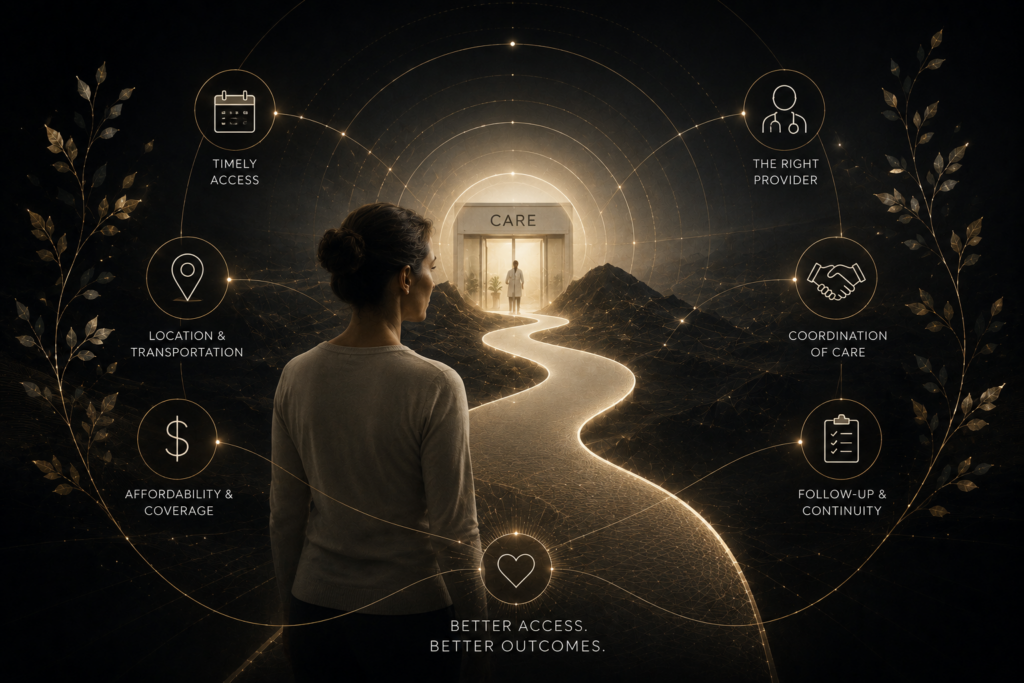
A treatment can be scientifically excellent and still fail if the person cannot reach it. A screening recommendation cannot protect someone who has no clinic nearby. A prescription cannot work if it costs more than the patient can afford. A specialist referral is not meaningful when the wait is a year, transportation is unavailable, interpretation is missing, or the appointment requires unpaid time away from work.
Access is often treated as an administrative problem surrounding healthcare. In reality, access is part of healthcare. The timing, cost, location, language, physical design, technology, and trustworthiness of care all influence outcomes.
Clinical access does not mean that every test or treatment must be available instantly. It means people can obtain appropriate services in a timely way, understand the plan, and continue care without unreasonable barriers.
When access fails, illness may be detected later, chronic conditions may worsen, medications may be interrupted, and preventable emergencies may become more likely. These outcomes are not simply the result of individual choices. They are shaped by the structure of the system.
Insurance Is Only One Part of Access
Health insurance can reduce the cost of care, but coverage does not guarantee that care is usable. A person may have insurance and still face a high deductible, narrow network, denied authorization, unaffordable medication, or a shortage of clinicians accepting new patients.
Plans differ in referral rules, covered services, pharmacies, laboratories, hospitals, and out-of-network costs. A clinician can be in network while the facility, anesthesiologist, pathology service, or laboratory is not.
Understanding every rule is difficult even for experienced patients. Access improves when systems provide clear cost estimates, current directories, understandable denial explanations, and meaningful assistance with appeals.
Time Is a Healthcare Resource
Appointments often occur during working hours. A person may need to arrange transportation, childcare, elder care, disability support, or several hours away from employment. Hourly workers and people without paid leave may lose income each time they seek care.
A short appointment can therefore carry a large hidden cost. Multiple referrals, repeated testing, and scheduling errors magnify that burden.
Even waiting is not neutral. Long delays may allow disease to progress or symptoms to become harder to treat. The patient may continue missing work, losing mobility, or living with uncertainty while waiting for a specialist.
Geography Shapes Clinical Possibility
Rural and underserved communities may have limited primary care, specialty care, maternity services, mental-health treatment, rehabilitation, pharmacy access, or emergency capacity. A referral may require hours of travel, overnight lodging, or crossing state lines.
Urban areas can also contain care deserts. Public transportation may not connect easily to medical centers. Traffic, mobility limitations, neighborhood safety, and parking cost can make a nearby clinic practically unreachable.
Telehealth can reduce some geographic barriers, but it cannot perform every examination or procedure. It also depends on broadband, devices, privacy, digital skills, and regulations that allow the clinician to treat someone in their location.
Language Access Is Clinical Safety
Healthcare requires more than translating individual words. Patients need to understand symptoms, consent, medication instructions, risks, follow-up, and when to seek urgent help.
Family members may want to interpret, but they may not know medical terminology, may filter information, or may be placed in an inappropriate role. Children should not carry the responsibility for interpreting complex or sensitive care.
Qualified medical interpreters improve communication and protect privacy. Written materials should also be available in languages and formats the person can use. Language access is not an optional courtesy. It is part of informed consent and safe treatment.
Health Literacy Is Shared Responsibility
Health literacy is often described as a patient’s ability to find, understand, and use health information. But organizations also have a responsibility to make information understandable.
Complex forms, unexplained abbreviations, rushed instructions, and portals filled with technical reports can create confusion for almost anyone, especially during illness or stress.
Clear communication includes plain language, visual aids, teach-back, translated material, and instructions that identify the next action. Teach-back asks the patient to explain the plan in their own words, not as a test, but as a check on whether the clinician communicated effectively.
Disability Access Goes Beyond the Entrance Ramp
Physical access may require ramps, elevators, accessible examination tables, transfer assistance, adequate room for mobility devices, and equipment that can accommodate different bodies.
Communication access may require sign-language interpretation, captioning, screen-reader compatible portals, large print, or additional time. People with sensory, intellectual, cognitive, or psychiatric disabilities may need adjustments in how information is presented and how appointments are structured.
When clinics lack appropriate equipment, people may receive incomplete examinations or be referred elsewhere for routine care. This can delay diagnosis and communicate that some bodies were not expected in the room.
Bias Changes Access Even When the Door Is Open
A person can reach the clinic and still not receive equitable care. Bias related to race, gender, weight, disability, age, income, substance use, mental health, or gender identity can affect which symptoms are believed, which tests are offered, and how pain is treated.
Previous discrimination may also reduce trust and make people less likely to return. This is sometimes described as patient reluctance, but reluctance may be a rational response to earlier harm.
Improving access therefore requires more than adding appointments. It requires care that is respectful, culturally responsive, trauma-informed, and willing to examine unequal patterns in diagnosis and treatment.
Digital Access Can Open and Close Doors
Patient portals, online scheduling, electronic forms, and telehealth can make care more convenient. They can also exclude people who lack broadband, devices, technical confidence, accessible software, or a private place to communicate.
A system that moves every task online may unintentionally make care harder for older adults, people with disabilities, people with limited English, and those facing financial instability.
Digital options should expand access rather than replace every human pathway. Telephone support, in-person assistance, and paper alternatives still matter.
Medication Access Is Part of Treatment
Prescribing is only the beginning of medication care. The pharmacy must have the drug. Insurance may require prior authorization. The copay must be affordable. The instructions must be clear. Refills must be available before the medication runs out.
People may ration doses, delay filling prescriptions, or stop treatment because of cost. These decisions are sometimes recorded as nonadherence without documenting the barrier.
Clinicians and pharmacists may be able to consider generics, alternative formulations, assistance programs, different pharmacies, synchronized refills, or a medically appropriate lower-cost option. The barrier needs to be named before it can be addressed.
Prior Authorization and Administrative Burden
Some services and medications require insurer approval before they are covered. Prior authorization may be intended to ensure appropriate use, but delays and denials can interrupt treatment or consume substantial staff and patient time.
Patients may not know whether the request was submitted, what information is missing, or who is responsible for an appeal. Clear tracking and communication can prevent people from disappearing between the clinic, pharmacy, and health plan.
When care is denied, ask for the reason in writing, the evidence needed, the deadline for appeal, and whether an expedited review is available when delay could cause harm.
Clinical Trials and Specialized Care
For rare, complex, or treatment-resistant conditions, clinical trials and academic centers may offer access to expertise or therapies not available locally. But participation can require travel, eligibility screening, time, and understanding of uncertain benefits and risks.
A clinical trial is research, not guaranteed treatment. Informed consent should explain the study purpose, alternatives, costs, responsibilities, and what happens if the participant withdraws.
Specialized care should not be presented as the only legitimate care. Community clinicians remain essential for ongoing treatment, monitoring, and support.
Patient Navigators, Social Workers, and Case Managers
Many people are unaware that navigation support may exist. Hospitals, cancer programs, insurers, community health centers, and nonprofit organizations may employ patient navigators, social workers, or case managers.
These professionals may help coordinate appointments, locate transportation, explain resources, support insurance appeals, connect patients with financial assistance, or organize care after discharge. Their exact roles vary.
Asking, “Is there someone who helps patients navigate this process?” can uncover support that is not automatically offered.
Safety-Net and Community Resources
Federally qualified health centers, local health departments, free or charitable clinics, teaching hospitals, and community programs may provide primary care, dental care, behavioral health, reproductive services, vaccination, screening, or medication assistance. Eligibility, cost, and services vary.
These resources do not erase the need for broader access, but they can provide meaningful care when traditional pathways are unavailable. Local 211 services, hospital financial-assistance offices, and public-health departments may help identify options.
When Access Barriers Become Urgent
Administrative delays should not prevent emergency care when symptoms suggest a life-threatening problem. Severe chest pain, difficulty breathing, signs of stroke, uncontrolled bleeding, severe allergic reaction, major injury, or immediate danger to self or others require urgent evaluation.
Financial concerns are real, but delaying emergency treatment can be dangerous. After stabilization, hospital financial counselors or assistance programs may help address cost.
Access Is Not a Character Test
People are often described as noncompliant when they miss appointments, do not complete testing, or stop medication. Sometimes the plan was medically inappropriate or poorly understood. Often the barrier was transportation, cost, work, caregiving, trauma, disability, or previous discrimination.
A missed appointment is an event, not a personality trait. Good care asks what prevented the plan from being possible.
This does not mean every barrier can be immediately solved. It means the care plan should be built around reality rather than an ideal patient with unlimited time, money, mobility, and support.
Access Is Part of the Treatment
Medical knowledge matters. Skilled clinicians matter. Advanced technology matters. But none of them can improve health when they remain unreachable.
Access is created through affordable coverage, available clinicians, transportation, interpretation, accessible facilities, respectful treatment, understandable information, and enough continuity to complete the plan.
When these elements fail, the consequences appear in the body: later diagnosis, interrupted medication, unmanaged pain, preventable complications, and lost function.
Clinical access is not outside the medical outcome. It helps create the outcome.
A healthcare system should not measure success only by what it can offer. It should also ask who can actually receive it.