

Pelvic health is often discussed only after something begins to go wrong.
A person leaks urine when they cough. Sex becomes painful. A feeling of heaviness develops in the vagina. Bowel movements require straining. Pelvic pain continues long after childbirth, surgery, or an injury appears to have healed.
These symptoms are common, but they are not simply inevitable parts of being female, having children, or getting older. They may reflect changes in the muscles, connective tissues, nerves, organs, breathing patterns, pressure systems, or pain pathways that work together within the pelvis.
The pelvic floor is sometimes described as a small group of muscles that should be strengthened through Kegel exercises. In reality, it is part of a much larger system. It must support the pelvic organs while also allowing urination, bowel movements, sexual activity, movement, breathing, pregnancy, and childbirth to occur.
It needs strength, but it also needs flexibility.
It must be able to contract, but it must also know how to release.
It responds to pressure from above, movement from below, and signals from the nervous system throughout the body.
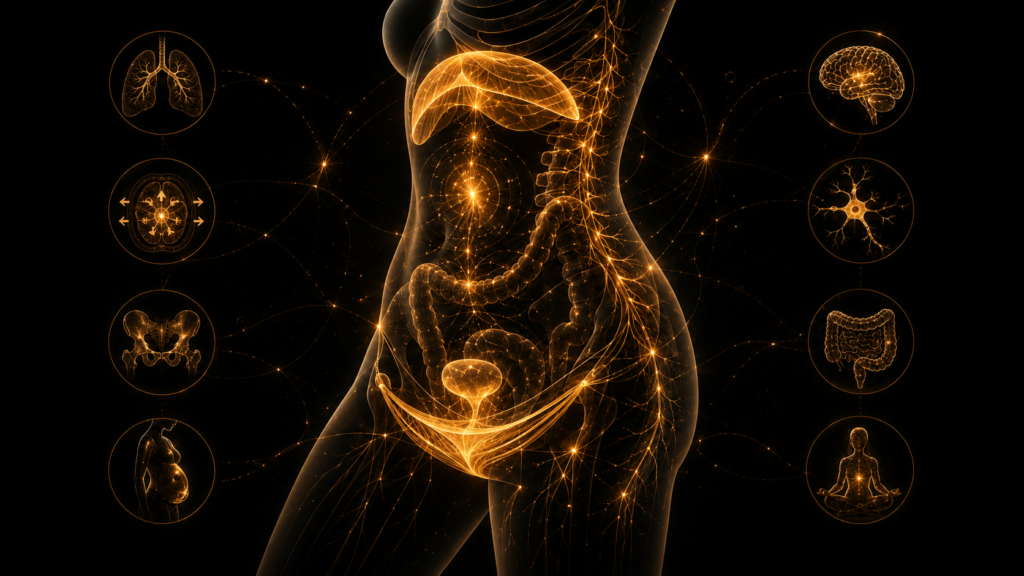
Pelvic health is therefore not limited to the pelvis. It is connected to the diaphragm, abdominal wall, hips, spine, bladder, bowel, reproductive organs, nervous system, hormones, and the way a person moves through daily life.
What the Pelvic Floor Actually Is
The pelvic floor is a layered group of muscles, connective tissues, ligaments, nerves, and supportive structures located at the base of the pelvis.
It stretches across the opening beneath the pelvic bones, creating a supportive foundation for organs including the bladder, uterus, vagina, urethra, and rectum. ACOG explains that these organs are supported by both the pelvic-floor muscles and layers of connective tissue. When those structures can no longer provide adequate support, pelvic organ prolapse may occur.
The pelvic floor contributes to several essential functions:
- Supporting the bladder, uterus, and bowel
- Helping control urination and bowel movements
- Allowing the release of urine and stool
- Contributing to sexual sensation and function
- Supporting pregnancy and participating in childbirth
- Responding to coughing, lifting, running, and other changes in pressure
- Working with the abdominal and back muscles to support the trunk
These functions require coordination rather than constant tension.
A healthy pelvic floor is not one that remains tightly contracted all day. It adjusts. It provides support when pressure rises, then softens when the body needs to urinate, have a bowel movement, engage in comfortable penetration, or give birth.
Problems may develop when the muscles are too weak, too tight, poorly coordinated, painful, injured, or unable to respond at the right time.
The Pelvic Floor Is Part of a Pressure System
The pelvis does not operate alone at the bottom of the body. It forms the lower boundary of a pressure-regulating system that also includes the diaphragm, abdominal wall, spine, and deep back muscles.
When the diaphragm moves downward during inhalation, pressure changes within the abdomen. The abdominal wall and pelvic floor must respond to that movement. During exhalation, lifting, coughing, laughing, or standing, the relationship changes again.
Pressure itself is not harmful. The body is designed to manage it.
Everyday activities create pressure, including:
- Breathing
- Coughing and sneezing
- Lifting
- Running and jumping
- Singing and laughing
- Bending and standing
- Bowel movements
- Pregnancy and childbirth
Symptoms can appear when pressure repeatedly exceeds the ability of the surrounding tissues to manage it or when the muscles do not coordinate efficiently.
For example, a person may hold their breath and bear down while lifting, sending pressure toward the pelvic floor. Another may keep the abdominal and pelvic muscles constantly braced, limiting their ability to absorb and release pressure. Chronic constipation may lead to repeated straining, placing additional stress on pelvic support structures.
The goal is not to avoid pressure. That would be impossible. The goal is for the diaphragm, abdominal wall, spine, and pelvic floor to share the work.
Pelvic-Floor Dysfunction Is Not Always Weakness
One of the most persistent misconceptions about pelvic health is that symptoms automatically mean the pelvic floor is weak.
Weakness can contribute to urine leakage, reduced support, or pelvic organ prolapse. But muscles can also become overly tense, shortened, painful, or unable to relax.
Some people have a combination of weakness and tension. A muscle that is constantly contracted may feel tight but still be functionally weak because it cannot move through its full range or generate force effectively.
Pelvic-floor dysfunction may involve:
- Reduced strength or endurance
- Excessive muscle tension
- Difficulty relaxing
- Poor timing or coordination
- Painful trigger points
- Scar restriction
- Nerve sensitivity
- Changes in connective-tissue support
- Difficulty sensing when the muscles are contracting or releasing
Cleveland Clinic describes pelvic-floor dysfunction as difficulty correctly relaxing and coordinating the pelvic-floor muscles, with possible symptoms including constipation, straining, urine or stool leakage, and urinary frequency.
This is why strengthening exercises are not appropriate for every person. A muscle that cannot release may need relaxation, mobility, coordination, and nervous-system support before additional strengthening is introduced.
Why Kegels Are Not a Universal Solution
Kegel exercises involve intentionally contracting the pelvic-floor muscles. They can be helpful for certain types of weakness or incontinence when performed correctly and included within an appropriate treatment plan.
But Kegels are not a universal prescription for every pelvic symptom.
If the pelvic floor is already excessively tense, repeated contractions may increase discomfort, urinary urgency, constipation, difficulty with penetration, or pelvic pain. If a person contracts the abdominal muscles, buttocks, or inner thighs instead of the intended muscles, the exercise may not address the actual problem.
Some people also perform Kegels by repeatedly stopping urine flow. While briefly identifying the muscles this way may sometimes be discussed, regularly interrupting urination is not generally recommended as a training method because it may interfere with normal bladder emptying.
Pelvic-floor exercise should be based on what the muscles are doing, not on the assumption that stronger is always better.
For one person, treatment may involve contraction and strengthening. For another, it may focus on breathing, releasing tension, improving bowel mechanics, reducing pain, or coordinating the muscles with movement.
The useful question is not, “Should everyone do Kegels?”
It is, “What does this person’s pelvic floor need to do more effectively?”
Bladder Control Depends on More Than Holding Tighter
Urinary leakage is one of the most recognized pelvic-health symptoms.
Stress urinary incontinence occurs when urine leaks during activities that increase abdominal pressure, such as coughing, sneezing, laughing, lifting, running, or jumping.
Urgency incontinence involves a sudden, difficult-to-control urge followed by leakage. Some people experience a mixture of both.
Bladder symptoms may also include:
- Urinating very frequently
- Waking repeatedly at night to urinate
- Difficulty beginning the urine stream
- Feeling unable to empty completely
- Pelvic or bladder pain
- Needing to strain to urinate
- Leakage on the way to the bathroom
NIDDK advises seeking medical care for bladder symptoms including difficulty urinating, loss of bladder control, waking to use the bathroom, pelvic pain, or urine leakage.
Pelvic-floor function can contribute to these symptoms, but it is not the only possible cause. Urinary tract infections, medication, pregnancy, neurological conditions, diabetes, pelvic organ prolapse, bladder conditions, menopause-related tissue changes, and other health concerns may also be involved.
The bladder and pelvic floor must coordinate. The muscles help maintain closure while urine is being stored, then relax appropriately during urination. Muscles that are too tense may make emptying difficult, while muscles that lack support or timing may contribute to leakage.
Simply trying to hold tighter may not correct either problem.
Bowel Function Also Requires Pelvic Coordination
The pelvic floor plays a major role in bowel movements.
To pass stool comfortably, the pelvic-floor muscles and anal sphincter must relax while the abdominal wall generates appropriate pressure. The rectum, bowel, nervous system, and surrounding muscles must coordinate the sequence.
When the pelvic floor contracts instead of releasing, stool may become difficult to pass even when it is not particularly hard. A person may strain, spend a long time on the toilet, feel incompletely emptied, or need to change position or use manual assistance.
Mayo Clinic notes that pelvic-floor dysfunction can be involved in chronic constipation and may present with straining, hard or thin stools, incomplete evacuation, abdominal pain, and other bowel symptoms.
Constipation can also affect pelvic health in the opposite direction. Repeated straining increases downward pressure on pelvic support structures and may worsen hemorrhoids, prolapse symptoms, pain, or muscular tension.
This can create a cycle:
Constipation leads to straining. Straining increases pelvic-floor stress. The muscles become more guarded or poorly coordinated. Bowel movements become even more difficult.
Treating the cycle may involve more than fiber or laxatives. Hydration, stool consistency, medication, digestive conditions, toilet positioning, breathing, pelvic-floor coordination, and behavioral patterns may all need consideration.
Pelvic Organ Prolapse Is a Support Problem, Not a Personal Failure
Pelvic organ prolapse occurs when the muscles and connective tissues supporting one or more pelvic organs are no longer able to maintain their usual position.
The bladder, uterus, vaginal walls, rectum, or the top of the vagina after hysterectomy may descend toward or through the vaginal opening.
Symptoms may include:
- Pelvic pressure or heaviness
- A feeling that something is falling or coming down
- A visible or palpable vaginal bulge
- Difficulty emptying the bladder
- Constipation or incomplete bowel emptying
- Lower-back discomfort
- Symptoms that worsen after standing or activity
- Difficulty keeping a tampon in place
- Changes in sexual comfort or function
Some people have anatomical prolapse without noticeable symptoms. ACOG notes that mild prolapse may be found during an examination even when a person is unaware of it.
Pregnancy and vaginal birth can increase the likelihood of prolapse, but they are not the only contributors. Aging, menopause, chronic constipation, repetitive heavy lifting, connective-tissue differences, coughing, obesity, surgery, and genetics may also influence support.
Prolapse is not evidence that a person moved incorrectly, failed to exercise, or did not recover well enough after childbirth.
Treatment depends on the type, severity, symptoms, and the person’s goals. Options may include pelvic-floor rehabilitation, activity modification, treatment of constipation or chronic cough, a vaginal support device called a pessary, or surgery.
The presence of prolapse does not always mean surgery is necessary. Treatment should be guided by how the condition affects comfort and daily function, not anatomy alone.
Pain Can Come From Muscles, Nerves, Organs, or Several at Once
Pelvic pain is not one diagnosis.
It may originate from reproductive organs, the bladder, bowel, pelvic-floor muscles, hips, abdominal wall, spine, scar tissue, nerves, or several overlapping sources.
Pain may feel:
- Aching or heavy
- Sharp or stabbing
- Burning
- Cramping
- Pulling or tearing
- Deep and difficult to locate
- Present only with touch or penetration
- Worse with sitting, movement, urination, or bowel movements
Conditions associated with pelvic pain may include endometriosis, adenomyosis, ovarian cysts, bladder pain syndrome, infection, irritable bowel syndrome, inflammatory bowel disease, pelvic-floor dysfunction, vulvodynia, nerve irritation, scar restriction, and musculoskeletal injury.
Because organs and muscles in the pelvis share nearby nerve pathways, the location of pain does not always reveal its source. A bowel condition may feel gynecological. Pelvic-floor tension may feel like bladder pressure. Hip or abdominal-wall pain may be experienced deep within the pelvis.
A person may also have more than one pain-generating condition.
Whole-body evaluation does not mean the pain is vague. It means the clinician may need to examine several connected systems rather than stopping after one test appears normal.
The Nervous System Can Keep the Pelvis on Guard
Pain changes the way the body moves.
When the pelvis hurts, muscles may tighten automatically to protect the area. This response may occur during menstruation, intercourse, bowel movements, urination, exercise, pregnancy, childbirth, surgery, or after a traumatic experience.
Short-term guarding can be protective. Persistent guarding may become part of the problem.
Muscles that remain tense may receive less circulation, develop painful areas, compress nearby structures, and lose the ability to coordinate normally. The nervous system may begin anticipating pain before an activity occurs.
Over time, the threshold for producing pain may lower. Touch, pressure, movement, or internal examination may feel more threatening even after the original tissue injury has improved.
This process does not mean the pain is psychological or imagined. It means the nervous system has become highly protective.
Treatment may include addressing the original medical condition while also helping the muscles and nervous system learn that certain movements, sensations, and activities can become safe again.
Breathing and the Pelvic Floor Move Together
The diaphragm and pelvic floor normally change position with each breath.
During a relaxed inhalation, the diaphragm descends and the pelvic floor may gently lengthen or lower in response. During exhalation, both structures return upward.
This motion helps distribute pressure and allows the pelvic floor to move rather than remain rigid.
Some people habitually hold their breath, brace their abdomen, grip the pelvic floor, or breathe primarily into the upper chest. These patterns may develop during stress, pain, exercise, pregnancy, after surgery, or while trying to maintain a constantly flattened abdomen.
Breathing exercises are not a cure for every pelvic-floor problem, but they can help restore awareness of pressure, movement, and relaxation.
A pelvic-health therapist may assess whether the ribs, abdomen, diaphragm, and pelvic floor are moving together. Treatment may then include breathing in different positions, coordinating exhalation with lifting, or learning to allow the pelvic floor to soften.
This is not simply relaxation for its own sake. It is mechanical retraining.
The Hips, Spine, and Abdominal Wall Share the Work
The pelvis is positioned between the trunk and legs. Every step, bend, lift, squat, and change in direction transfers force through the region.
Hip muscles help control the movement of the pelvis and thighs. The abdominal wall helps manage pressure and trunk stability. The spinal muscles contribute to posture and movement. The pelvic floor responds to all of them.
When one region is painful, weak, rigid, or poorly coordinated, another may compensate.
A person with hip pain may change the way they walk and increase tension through the pelvic floor. Someone with abdominal surgery may guard the abdomen and alter breathing. Persistent lower-back pain may coexist with pelvic-floor dysfunction because both regions participate in stabilizing the trunk.
This does not mean poor posture causes all pelvic symptoms. The body has many safe ways to sit and move, and no single posture must be maintained all day.
The more useful question is whether the body can vary position, transfer load, breathe, and move without repeatedly creating pain or pressure.
Pelvic health depends on adaptability, not perfect posture.
Sexual Pain Should Not Be Normalized
Pain during penetration or sexual activity is common, but common does not mean harmless or inevitable.
Pain may occur at the vaginal opening, deeper within the pelvis, during arousal, with penetration, after sex, or with orgasm.
Possible contributors include:
- Pelvic-floor tension
- Endometriosis or adenomyosis
- Vulvodynia
- Infection
- Vaginal dryness or tissue changes
- Scar tissue
- Hormonal changes
- Bladder or bowel conditions
- Nerve sensitivity
- Past injury, surgery, childbirth, or trauma
- Inadequate arousal, lubrication, or comfort
The pelvic floor must be able to lengthen and accommodate penetration. When the muscles anticipate pain or feel threatened, they may contract involuntarily, increasing discomfort.
Telling someone to relax is rarely enough. Relaxation is difficult when the nervous system expects pain.
Treatment may include medical evaluation, pelvic-floor physical therapy, treatment of hormonal or inflammatory conditions, gradual exposure, pain education, changes in sexual activity, counseling, or other support depending on the cause.
Sex should not require enduring pain to prove that the body is normal or the relationship is healthy.
Pregnancy Changes the Entire Pressure System
Pregnancy places increasing demands on the pelvic floor, abdominal wall, spine, hips, circulation, and connective tissues.
The growing uterus adds weight and changes the distribution of pressure. Hormonal shifts affect ligaments and tissues. Breathing mechanics may change as the uterus rises within the abdomen. Constipation, urinary frequency, pelvic pain, and heaviness may develop.
The pelvic floor does not simply need to become stronger during pregnancy. It must continue supporting the organs while also remaining flexible enough to adapt to growth and, in many births, allow the baby to pass through the pelvis.
Preparation may involve strength, relaxation, mobility, breathing, pressure management, and learning positions that feel supportive.
Pregnancy-related pelvic pain or leakage should not automatically be dismissed as something that must be endured until delivery. Assessment may help identify ways to improve comfort, movement, bowel habits, and daily function.
Birth Can Affect Muscles, Nerves, and Connective Tissue
Vaginal birth requires the pelvic-floor muscles and surrounding tissues to stretch significantly. Tearing, episiotomy, prolonged pushing, assisted delivery, fetal position, birth weight, and individual anatomy may influence recovery.
Nerves may also be stretched or compressed. The abdominal wall and connective tissues have already adapted through pregnancy, while sleep deprivation, feeding demands, hormonal changes, and caring for a newborn shape the postpartum environment.
Cesarean birth avoids some forms of direct pelvic-floor stretching, but it does not eliminate pelvic-health concerns. Pregnancy itself affects pelvic support, and abdominal surgery may influence scar mobility, sensation, breathing, movement, and pressure management.
Postpartum symptoms may include:
- Urinary or bowel leakage
- Pelvic pressure or prolapse symptoms
- Constipation
- Pain with sex
- Perineal or scar pain
- Abdominal weakness or separation
- Tailbone, hip, or back pain
- Difficulty returning to exercise
- Numbness or altered sensation
APTA notes that pelvic-health physical therapy may assist postpartum recovery through support for muscle control, tissue repair, and internal portions of cesarean scar healing.
Recovery is not defined only by whether a medical emergency occurred during birth. A person may have had an uncomplicated delivery and still need rehabilitation.
Postpartum Recovery Does Not End at Six Weeks
The six-week postpartum appointment is often treated as the finish line for recovery.
In reality, healing and adaptation continue much longer. Muscles, connective tissues, nerves, scars, sleep, hormones, feeding demands, and daily movement may continue changing for months.
A brief examination may confirm that tissue has closed and no immediate complication is present, but it does not necessarily assess strength, pressure management, painful intercourse, bowel coordination, return to exercise, or the emotional experience of birth and recovery.
Symptoms such as leakage, heaviness, pain, or pressure should not be accepted simply because a person has recently given birth.
The body may need gradual rehabilitation rather than immediate return to previous activity. This can include learning how to breathe and move with pressure, restoring hip and abdominal function, retraining the pelvic floor, and pacing activity as symptoms change.
Postpartum care should not require someone to wait until dysfunction becomes severe.
Menopause Can Change Pelvic Tissues and Symptoms
Estrogen influences tissues throughout the urinary and reproductive systems.
During perimenopause and menopause, changes in estrogen may contribute to vaginal dryness, irritation, urinary urgency, recurrent urinary symptoms, discomfort during sex, and changes in tissue resilience.
Aging may also affect muscle mass, collagen, connective tissues, and the ability to recover from strain. These changes can interact with previous pregnancies, surgeries, constipation, coughing, physical demands, and genetic factors.
Pelvic symptoms appearing during menopause are not necessarily caused by weakness alone.
Treatment may involve pelvic-floor rehabilitation, bladder or bowel strategies, moisturizers or lubricants, treatment for prolapse, and local or systemic hormone therapy when medically appropriate.
Aging changes the pelvic environment, but pain, leakage, and loss of function should not be dismissed as unavoidable.
Stress and Trauma Can Be Held in Muscular Patterns
The pelvic floor responds to the nervous system’s perception of safety and threat.
During stress, people may tighten the jaw, shoulders, abdomen, buttocks, or pelvic floor without realizing it. When this response becomes habitual, the muscles may spend much of the day partially contracted.
A history of sexual trauma, medical trauma, painful examinations, difficult birth, chronic pain, or other distress may also affect how the nervous system responds to touch and internal sensation.
This does not mean pelvic symptoms are caused by emotions alone. Muscles, nerves, scars, organs, inflammation, and tissue conditions remain physically real.
It means emotional and physical experiences can become connected through the nervous system.
Trauma-informed pelvic care emphasizes consent, communication, control, pacing, and the right to stop an examination or treatment at any time.
A person should never be pressured into an internal assessment because it is considered standard. Care must remain collaborative.
What Pelvic-Health Physical Therapy Involves
Pelvic-health physical therapy is a specialized area of rehabilitation focused on pelvic, abdominal, bladder, bowel, sexual, pregnancy, postpartum, and pain-related concerns.
An initial appointment may include questions about symptoms, bathroom habits, pain, movement, pregnancy history, surgery, sexual function, exercise, and the effect of symptoms on daily life. APTA’s patient guidance describes assessment as individualized and notes that treatment may address bladder or bowel problems, pelvic pain, postpartum recovery, and sexual-health concerns.
The physical examination may assess:
- Breathing
- Posture and movement
- Hip and spinal mobility
- Abdominal-wall function
- Scars
- Muscle strength and coordination
- Areas of tenderness
- The ability to contract and relax the pelvic floor
- Bowel or bladder mechanics
An internal vaginal or rectal examination may sometimes provide useful information, but it should only occur with informed consent. It is not required at every appointment, and alternatives can be used when someone declines or is not ready.
Treatment may include education, breathing exercises, manual therapy, muscle retraining, strengthening, relaxation, bowel or bladder strategies, scar work, gradual return to activity, and an individualized home program.
The goal is not to make every pelvic floor stronger. It is to help the entire system function more effectively.
Bathroom Habits Can Shape Pelvic Function
Everyday bathroom behaviors may influence the pelvic floor.
Frequently urinating “just in case” can train the bladder to signal urgency at smaller volumes in some people. Habitually delaying urination for very long periods may also create problems.
Straining to force urine or stool out can increase downward pressure. Hovering above a toilet may prevent the pelvic floor from relaxing fully. Rushing can make emptying more difficult.
Healthy bathroom habits may include:
- Responding to normal bladder and bowel signals when reasonably possible
- Sitting fully supported on the toilet
- Avoiding forceful straining
- Allowing enough time without lingering excessively
- Supporting comfortable stool consistency
- Using a footstool when helpful for bowel positioning
- Seeking care for ongoing constipation, urgency, pain, or incomplete emptying
These practices are not strict rules, and no one follows them perfectly. They are ways of reducing unnecessary conflict between the pelvic floor and the organs it helps control.
Movement Should Be Adapted, Not Feared
People with leakage, pain, or prolapse symptoms may become afraid of lifting, running, jumping, or exercise.
Certain activities may temporarily increase symptoms, particularly when the pelvic floor is healing or pressure is not being managed effectively. But complete avoidance can lead to reduced strength, confidence, bone health, cardiovascular fitness, and participation in daily life.
The goal is not to declare activities universally safe or unsafe. It is to identify what the body can currently manage and build capacity gradually.
This may involve:
- Adjusting load or impact
- Exhaling during effort
- Changing stance or technique
- Reducing repetitions
- Allowing recovery between sessions
- Strengthening the hips, trunk, and pelvic floor
- Treating constipation, pain, or other contributors
- Monitoring whether symptoms remain stable or worsen afterward
A symptom is information, not always a command to stop moving forever.
Rehabilitation should help people return to meaningful activity whenever possible, not build a smaller life around the pelvis.
When Pelvic Symptoms Need Medical Evaluation
Pelvic-floor dysfunction can cause many symptoms, but not every pelvic symptom originates in the muscles.
Medical evaluation is important for:
- Sudden or severe pelvic or abdominal pain
- Heavy or unexplained bleeding
- Blood in the urine or stool
- Fever, vomiting, or signs of infection
- Inability to urinate
- New numbness or weakness
- A rapidly growing or painful mass
- Unexplained weight loss
- Persistent pain during sex
- A vaginal bulge or increasing pelvic pressure
- Urine or stool leakage
- Constipation that does not improve
- Symptoms that interfere with sleep or daily life
Acute inability to urinate can require urgent care. NIDDK describes acute urinary retention as potentially severe, with symptoms including abdominal pain and the inability to urinate.
A pelvic-health therapist can be valuable, but therapy should not replace medical assessment when symptoms could involve infection, endometriosis, cancer, neurological disease, organ dysfunction, pregnancy complications, or another condition requiring specific treatment.
Pelvic Health Deserves to Be Discussed Before a Crisis
Pelvic symptoms are frequently hidden because they involve urination, bowel movements, sexual function, or reproductive anatomy.
People may feel embarrassed, assume they are alone, or believe nothing can be done. Some are told that symptoms are normal after childbirth or simply part of aging.
Silence allows treatable problems to become more disruptive.
Pelvic health can be discussed during adolescence, pregnancy, postpartum recovery, menopause, surgery preparation, athletic training, and ordinary preventive care. People should not have to wait until they are leaking daily, avoiding sex, unable to empty their bowels, or living with severe pain.
Education does not need to make everyone hyperaware of the pelvis. It simply creates language for recognizing when support may be useful.
The Pelvis Is Not an Isolated Container
The pelvic floor does not function as a small hammock quietly holding organs in place.
It moves with the breath. It responds to the abdominal wall. It absorbs force from the legs and transfers pressure from the trunk. It coordinates with the bladder and bowel. It changes during the menstrual cycle, pregnancy, birth, postpartum recovery, and menopause.
It reacts to pain, stress, injury, surgery, inflammation, and the nervous system’s perception of safety.
Symptoms may appear in the pelvis, but the contributing patterns may reach through the whole body.
This is why pelvic health cannot be reduced to one muscle exercise.
A person may need strength, but they may also need release.
They may need support, but they may also need mobility.
They may need treatment for the pelvic floor, but they may also need care for the bowel, bladder, reproductive organs, spine, hips, hormones, scars, or nervous system.
Pelvic health is not merely the absence of leakage, pain, or prolapse. It is the ability to support, release, adapt, move, and participate in life without the pelvis becoming a constant source of fear or limitation.
The pelvic floor is one part of the body.
Its health depends on the conversation it is having with everything around it.