

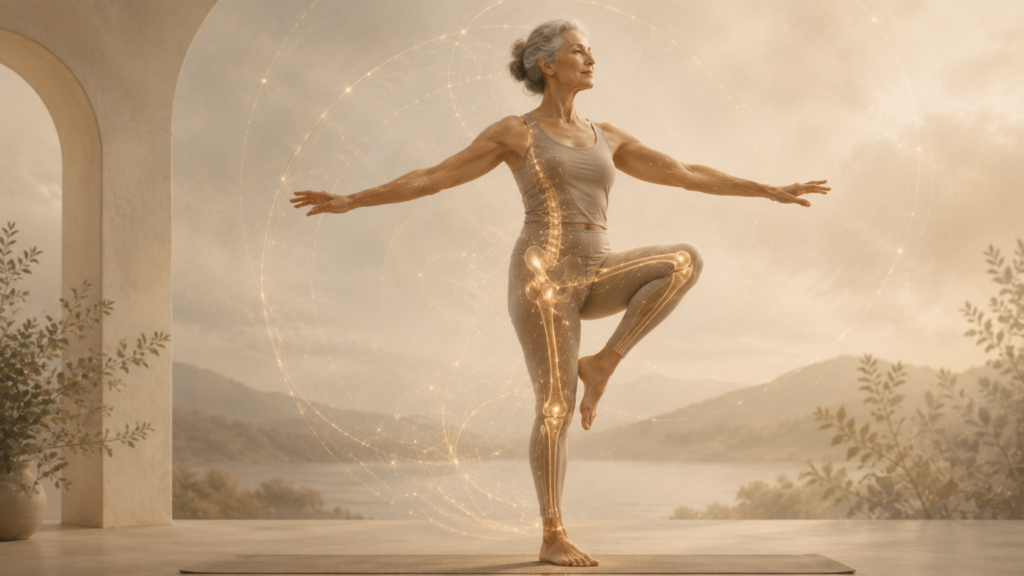
Why strength, skeletal health, coordination, and the environment matter for staying capable across the lifespan.
Independence is often discussed as a matter of living arrangements or whether someone needs help. Beneath those visible outcomes are physical capacities that make ordinary life possible.
Standing from a chair requires leg strength and coordination. Carrying groceries requires grip, balance, and trunk control. Stepping over a curb requires vision, joint mobility, and the ability to shift weight quickly. Recovering from a stumble depends on reaction time, muscle power, and confidence.
These abilities are rarely built at the moment they become necessary. They are supported by muscle, bone, balance, and movement habits accumulated across the lifespan.
Healthy aging is not about preserving a youthful body. It is about maintaining enough physical reserve to keep participating in life.
Muscle Is a Reserve System
Muscle moves the body, but its role extends beyond movement. It stores amino acids, supports glucose regulation, contributes to heat production, protects joints, and helps the body respond to illness and injury.
During hospitalization, infection, or prolonged inactivity, the body may lose muscle quickly. A person with greater reserve has more capacity to absorb that loss before everyday function is affected.
Muscle strength often matters more to independence than appearance or size. The ability to generate force quickly can determine whether someone catches themselves during a stumble, rises from the floor, or climbs stairs safely.
Age-Related Muscle Loss Is Not Entirely Inevitable
Muscle mass and strength commonly decline with age, a process that can progress into sarcopenia when loss becomes clinically significant. Aging contributes through hormonal changes, reduced nerve input, anabolic resistance, illness, and changes in activity.
Inactivity is a major accelerator. When daily life requires less lifting, climbing, walking, and carrying, the body receives fewer reasons to maintain capacity.
Resistance training remains effective in later life. Progress may look different than it did decades earlier, but older muscle can still respond to appropriately designed strength work.
Bone Responds to Load
Bone is living tissue. It is constantly being broken down and rebuilt in response to hormones, nutrition, medication, health conditions, and mechanical loading.
Weight-bearing activity and resistance exercise provide signals that help maintain skeletal strength. Calcium, vitamin D, adequate nutrition, and hormonal health also contribute, but no single nutrient can replace the need for movement or medical evaluation.
Bone density often receives attention after menopause because declining estrogen can accelerate bone loss. Men and younger adults can also develop osteoporosis, particularly with certain medications, endocrine conditions, malabsorption, low body weight, smoking, or prolonged inactivity.
A Fracture Is More Than a Bone Event
A fracture can affect mobility, confidence, sleep, independence, and social participation. Recovery may involve surgery, pain, temporary inactivity, and loss of muscle in addition to the bone injury itself.
This is why fracture prevention is not limited to improving bone density. It also involves reducing falls, improving strength and balance, reviewing medications, supporting vision and hearing, and making the environment safer.
Strong bones matter. So does avoiding the force that breaks them.
Balance Is a Multi-System Skill
Balance is not one sense located in one part of the body. It emerges from communication among vision, the inner ear, sensation from the feet and joints, muscle strength, reaction time, and the brain’s ability to integrate information.
A change in any one system can affect stability. Dim lighting reduces visual information. Neuropathy can reduce sensation from the feet. Ear disorders may disrupt vestibular input. Weak hips can make it harder to correct a sideways loss of balance.
Medication, dehydration, low blood pressure, illness, and fatigue can also change balance from day to day. This is why falls should not be dismissed as clumsiness or an inevitable consequence of age.
Power Matters as Much as Strength
Strength describes the ability to produce force. Power includes how quickly that force can be produced.
Many real-life situations require speed. A person must react quickly to catch a railing, step away from an obstacle, or regain balance after a trip. Power tends to decline faster than basic strength, which makes safe, appropriately supervised training important.
Power training does not always mean jumping or explosive exercise. It may involve standing from a chair with intention, climbing a step, or moving a light resistance more quickly while maintaining control.
Walking Is Important but Not Sufficient
Walking supports cardiovascular health, endurance, mood, circulation, and participation. It is one of the most accessible forms of movement.
However, walking alone may not provide enough resistance to preserve all muscle groups or challenge balance in multiple directions. A person can walk regularly and still struggle to rise from the floor, carry a heavy object, or recover from a sideways stumble.
A complete movement pattern usually includes aerobic activity, resistance, balance practice, mobility, and tasks that resemble everyday life.
Fear of Falling Can Shrink Function
After a fall or near-fall, people may reduce activity to stay safe. This response is understandable. Unfortunately, avoiding movement can lead to weaker muscles, slower reactions, reduced confidence, and greater fall risk.
The answer is not to ignore fear or push through unsafe situations. It is to rebuild capacity in a controlled environment. Physical therapy, assistive devices, strength training, and home modifications can create a safer path back to activity.
Confidence is not merely a personality trait. It grows when the body repeatedly demonstrates that it can manage a task.
The Home Can Support or Undermine Capacity
Functional ability is shaped by the interaction between the person and the environment. A small decline in vision or balance may have little effect in a well-lit, accessible home and a major effect in a space with loose rugs, poor railings, narrow pathways, or steep stairs.
Helpful changes may include brighter lighting, secure handrails, non-slip surfaces, frequently used items stored within easy reach, appropriate footwear, and clear walking paths.
Using an assistive device is not a failure of independence. A cane, walker, grab bar, or raised seat can preserve participation by reducing unnecessary risk.
Nutrition Supports the Structure
Muscle and bone require adequate energy and nutrients. Protein supports muscle repair. Calcium and vitamin D contribute to bone health. Overall dietary quality influences cardiovascular, metabolic, and immune function.
Appetite may decline with age, illness, medication, dental problems, grief, or social isolation. Eating enough can become more difficult at the same time that recovery requires greater nutritional attention.
Supplements may be useful when a deficiency or medical need is present, but they cannot replace assessment of poor appetite, swallowing difficulty, weight loss, or limited food access.
How to Build Physical Reserve
The most useful program is one that is safe, progressive, and sustainable. It does not need to resemble athletic training.
A balanced approach may include:
- Resistance exercises for the legs, hips, back, chest, arms, and grip.
- Weight-bearing activity appropriate to bone and joint health.
- Balance practice near stable support.
- Walking or other aerobic movement.
- Tasks such as carrying, stair climbing, and rising from the floor when appropriate.
- Rest and recovery matched to health status.
- Professional guidance after falls, fractures, surgery, neurological symptoms, or significant pain.
Progress can be measured through function: standing more easily, walking farther, carrying more confidently, or needing less assistance.
When Changes Need Evaluation
A gradual decline in activity can be easy to normalize, but some changes deserve medical attention. Repeated falls, unexplained weakness, new numbness, sudden balance problems, significant height loss, persistent bone pain, or difficulty completing basic tasks should be evaluated.
Falls can signal medication effects, vision problems, cardiovascular conditions, neurological disease, infection, or environmental hazards. Weakness can reflect anemia, endocrine disease, nutritional deficiency, or many other conditions.
Aging may change capacity, but it should not become an explanation that prevents investigation.
Independence Is Built Through Capacity and Support
No person remains independent through physical ability alone. Everyone depends on environments, tools, relationships, and systems.
The goal is not to avoid all assistance. It is to preserve the ability to make choices, participate, and do what matters with the right level of support.
Muscle provides force. Bone provides structure. Balance allows the body to organize itself in space. The environment determines how those capacities can be used.
Together, they create the physical foundation for independence, not as a performance of self-sufficiency, but as continued access to a meaningful life.





