

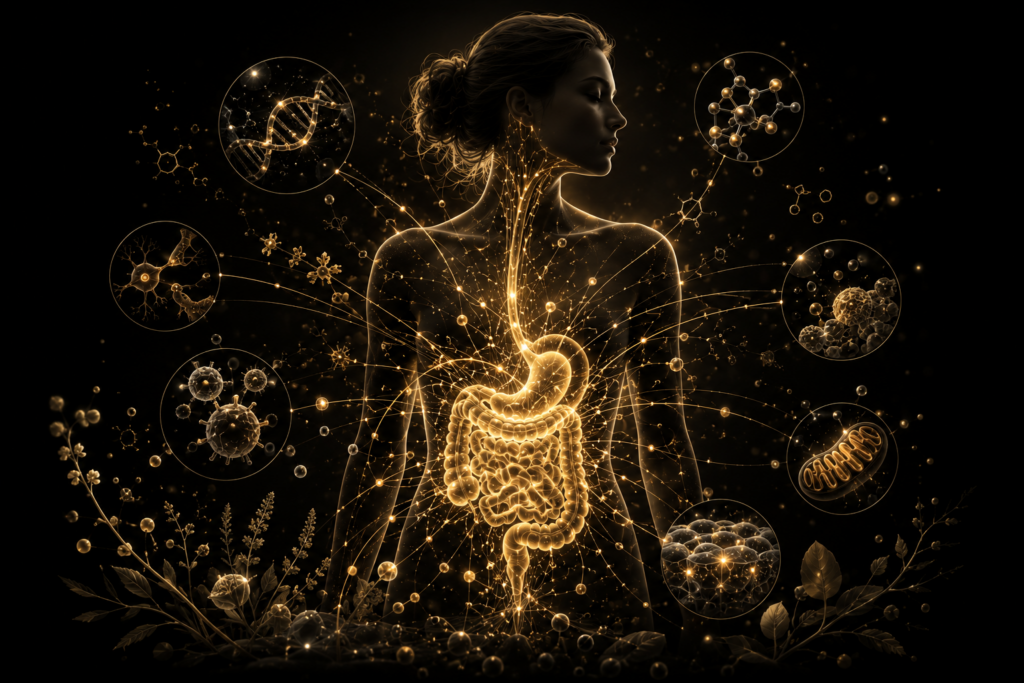
Food is often framed as fuel. Calories in, calories out. Energy consumed, energy expended. That model is useful for basic arithmetic, but it is incomplete at a biological level.
Food is not only energy.
Food is information.
Every meal sends signals into the body that influence hormonal activity, immune response, gut microbiome composition, nervous system state, and metabolic regulation. The body does not just “burn” food. It interprets it.
This means diet is not only a matter of intake.
It is a continuous signaling environment that shapes physiology over time.
Food as a biological signaling system
When food enters the body, it triggers far more than digestion. It activates endocrine responses, microbial interactions, immune signaling pathways, and neural feedback loops that collectively determine how the body will behave after eating.
Macronutrients are part of this signal. So are micronutrients. So are fiber types, food structure, timing of intake, and even the metabolic context in which food is consumed.
Carbohydrates influence insulin signaling and energy availability patterns. Proteins influence satiety hormones and tissue repair signaling. Fats influence hormonal synthesis and inflammatory modulation.
But none of these operate in isolation.
The body reads food as a composite signal.
Not a single input.
The gut as the first interpreter of food signals
Before nutrients ever reach systemic circulation, they interact with the gut environment.
The gut determines how food is processed, absorbed, or metabolically transformed based on:
- enzyme activity
- microbial composition
- intestinal barrier integrity
- immune signaling activity
- current inflammatory state
This means the same food can produce different biological effects depending on gut conditions at the time of consumption.
Food is not interpreted uniformly across all bodies or all states.
It is context dependent.
The gut is the first layer of interpretation, and it heavily influences downstream hormonal and metabolic responses.
Food and hormonal signaling are directly linked
Every eating event triggers hormonal responses that regulate energy storage, utilization, and distribution.
Insulin responds to glucose availability. Cortisol interacts with metabolic demand and stress state. Ghrelin and leptin regulate hunger and satiety signaling. Thyroid hormones adjust metabolic rate over longer time scales.
These systems are not passive responders.
They actively interpret food as a signal about environmental conditions.
Frequent energy availability signals safety and abundance. Irregular intake signals variability. High stress combined with food intake can alter how nutrients are partitioned and stored.
Over time, dietary patterns help shape baseline hormonal behavior.
Food is therefore not separate from hormonal health.
It is one of its primary regulators.
The microbiome as a dietary feedback system
The gut microbiome is one of the most responsive biological systems to dietary input.
Microbial populations shift based on what is consistently available in the diet. These shifts influence:
- inflammation levels
- nutrient absorption efficiency
- neurotransmitter precursor production
- metabolic byproduct formation
- immune system calibration
In this way, food does not only feed the body.
It feeds the microbial ecosystem that helps regulate the body.
Different dietary patterns create different microbial environments, which in turn influence how the body responds to future food intake.
This creates a feedback loop between diet, microbiome, and physiology.
Food becomes part of a self-reinforcing regulatory system.
Food and the nervous system: safety, threat, and regulation
The nervous system does not interpret food purely through digestion.
It also interprets food through safety signaling.
Eating in a calm state produces different physiological responses than eating in a stressed state. Meal timing, environment, emotional context, and physiological stress load all influence how the nervous system modulates digestion and metabolic processing.
When the nervous system is in a regulated state, digestion is more efficient and metabolic responses are more stable.
When the nervous system is in a stressed or activated state, digestion may slow, hormonal responses may shift, and energy allocation may prioritize immediate survival mechanisms over long-term metabolic balance.
This is why the same meal can feel different depending on internal state.
Food is not processed in isolation from the nervous system.
It is processed through it.
Food as a long-term signaling environment
Diet is not only about individual meals. It is about repeated signaling over time.
The body responds less to single dietary events and more to patterns of intake. Consistency in food signals shapes baseline metabolic behavior, gut microbiome composition, hormonal responsiveness, and inflammatory tone.
Over time, these repeated signals become part of the body’s regulatory expectations.
This is why dietary patterns can influence:
- energy stability across the day
- hormonal cycling behavior
- inflammatory baseline levels
- gut resilience and microbial diversity
- stress response sensitivity
Food becomes a long-term programming input rather than a short-term fuel source.
Why “healthy food” is not a universal signal
One of the limitations of simplistic nutrition models is the assumption that certain foods produce universal outcomes.
In reality, biological response to food is highly context dependent.
The same food can produce different effects depending on:
- gut microbiome composition
- hormonal state
- stress levels
- metabolic flexibility
- circadian timing
- inflammatory baseline
This is why standardized dietary advice often produces inconsistent results across individuals.
Food is not inherently good or bad in isolation.
It is a signal interpreted by a dynamic system.
Timing changes the meaning of food
When food is consumed is often as important as what is consumed.
Circadian rhythm influences insulin sensitivity, digestive enzyme activity, and metabolic efficiency. The same meal eaten at different times of day can produce different hormonal and metabolic responses.
Morning intake may support different signaling pathways than evening intake. Irregular eating patterns may create different metabolic adaptations than structured timing.
Food is therefore not only biochemical.
It is temporal.
The body interprets food differently depending on when it arrives relative to internal biological rhythms.
Food as system input, not isolated variable
When food is viewed as signal rather than fuel, diet becomes part of a larger regulatory network involving the gut, brain, hormones, and metabolism.
Every eating pattern contributes to shaping:
- metabolic flexibility
- hormonal rhythm stability
- gut microbial composition
- nervous system regulation
- inflammatory baseline activity
This means dietary choices are not isolated decisions.
They are ongoing inputs into a dynamic biological system.
Conclusion: food is biological communication
Food is not simply consumed.
It is interpreted.
It sends layered signals into the body that influence how systems behave over time. The gut processes it, the microbiome responds to it, hormones adjust to it, and the nervous system integrates it into overall regulatory state.
Understanding food as signal shifts nutrition away from static rules and toward dynamic interaction.
The question is no longer only what is being eaten.
It becomes what the body is being signaled to do as a result of what is being eaten.
Food is not just fuel.
It is one of the primary languages the body uses to regulate itself.





