

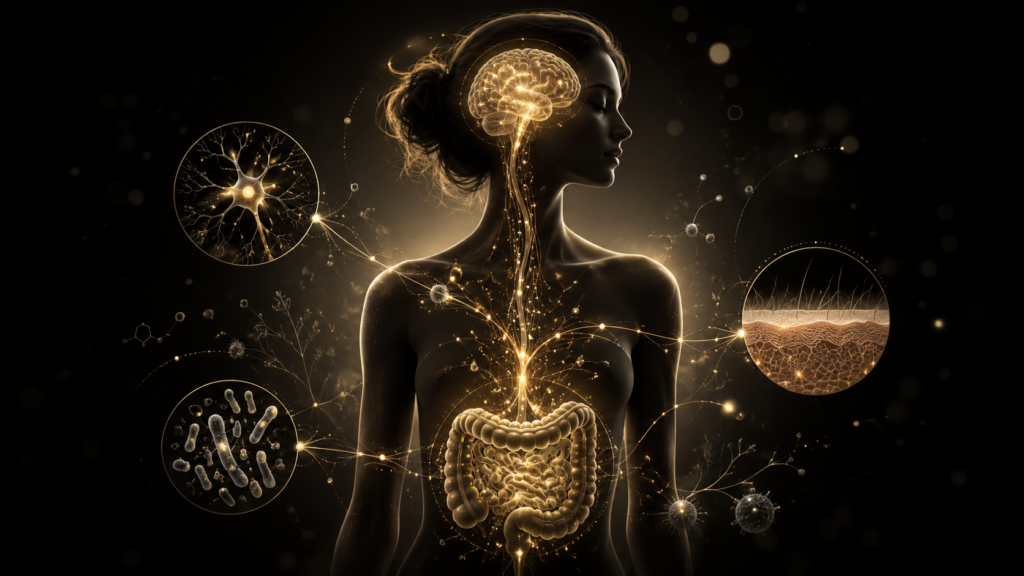
The gut, brain, and skin are often presented as separate biological systems, each belonging to a different branch of medicine. The gut belongs to digestion. The brain belongs to neurology and psychology. The skin belongs to dermatology.
But this separation is clinical convenience, not biological reality.
In physiology, these three systems are not independent. They are tightly integrated communication surfaces within a single regulatory network that continuously exchanges signals through immune pathways, neural circuits, microbial metabolites, and endocrine signaling.
The gut-brain-skin axis is not a conceptual framework.
It is a functional biological loop.
And when one part of that loop changes, the others respond not sequentially, but simultaneously.
The gut as a central regulatory interface
The gut is often described as a digestive organ, but this description is incomplete at a functional level.
The gastrointestinal tract is one of the largest immune interfaces in the human body. It is also a major site of microbial-host interaction, neurotransmitter production, and metabolic signaling exchange.
The intestinal lining is not just absorbing nutrients. It is constantly evaluating, filtering, and responding to a wide range of inputs including:
- dietary components and their breakdown products
- microbial metabolites produced by the gut microbiome
- inflammatory and immune signaling molecules
- hormonal signals circulating through systemic pathways
- stress-related neurochemical input from the nervous system
This makes the gut less of a digestive endpoint and more of a dynamic regulatory interface between the external environment and internal physiology.
At any given moment, it is not just processing food.
It is processing information.
The microbiome as a metabolic signaling organ
Within the gut exists a complex ecosystem of microorganisms collectively referred to as the microbiome.
These microbial populations are not passive residents. They actively participate in biochemical production and signaling processes that influence host physiology.
They contribute to:
- short-chain fatty acid production that influences inflammation and energy metabolism
- neurotransmitter precursor modulation that affects brain chemistry
- bile acid transformation that influences fat metabolism and hormone recycling
- immune system training and calibration through constant exposure signaling
In this sense, the microbiome functions as a metabolic signaling organ layered on top of human physiology.
It does not replace host systems.
It modulates them.
And because it is highly responsive to diet, stress, sleep, and environmental exposure, it becomes one of the most dynamic regulators of systemic health.
The brain-gut communication loop is continuous, not reactive
The gut and brain communicate through multiple overlapping pathways. The most well-known is the vagus nerve, but the system is not limited to neural signaling.
There is also constant bidirectional communication through:
- immune cytokines
- hormonal signaling molecules
- microbial metabolites
- neurotransmitter precursors produced in the gut environment
This creates a continuous feedback loop between digestive state and neural state.
The brain is not waiting for gut signals to arrive.
It is continuously receiving updates about:
- inflammatory activity in the gut environment
- microbial composition and metabolic output
- nutrient availability and absorption efficiency
- immune system activation status
In response, the brain adjusts:
- stress sensitivity thresholds
- emotional regulation capacity
- sleep-wake signaling balance
- energy allocation priorities
- cognitive clarity and focus patterns
This is why gut disruption can manifest as fatigue, anxiety, brain fog, or mood variability long before overt digestive symptoms are recognized.
The brain is not reacting after digestion.
It is regulating in real time based on gut-derived information.
The skin as an external immune and metabolic expression layer
The skin is often perceived as a protective outer barrier, but functionally it is an active immunological and metabolic interface.
It is involved in:
- barrier defense against environmental exposure
- immune signaling through inflammatory mediator activity
- thermoregulation and vascular response
- metabolic waste and oxidative stress expression
- microbiome-host interaction at the skin surface
Because of this, the skin becomes one of the most visible expression layers of internal physiological state.
Changes in gut and brain signaling frequently appear in the skin as:
- altered inflammatory response patterns
- changes in barrier integrity and hydration balance
- shifts in microbiome balance at the skin surface
- variability in tissue repair and regeneration speed
These are not isolated dermatological issues.
They are external expressions of internal regulatory activity.
The skin is not reacting independently.
It is reflecting system-wide signaling conditions.
The axis as a unified signaling network
The gut-brain-skin axis is not three systems influencing each other occasionally.
It is one continuous communication loop expressed across different tissues.
The gut processes and interprets external input and microbial activity.
The brain integrates that information into emotional, cognitive, and autonomic regulation.
The skin expresses downstream immune, inflammatory, and metabolic states externally.
These are not separate conversations.
They are different expression layers of the same biological dialogue.
When internal signaling is coherent, all three systems tend to stabilize together.
When signaling becomes disrupted, the effects appear distributed rather than localized.
This distributed pattern is what often creates confusion in symptom interpretation.
The system feels fragmented, but the underlying regulation is still unified.
Why isolated treatment often produces incomplete results
One of the most common limitations in addressing gut, brain, or skin concerns is treating each system as independent.
For example, interventions may focus solely on skin symptoms without addressing gut-derived inflammatory signaling. Or mood and cognitive changes may be addressed without considering microbial or immune contributions originating in the gut environment. Or digestive symptoms may be treated without accounting for nervous system regulation or stress-related signaling input.
Because these systems are deeply interconnected, isolated intervention often produces partial or temporary results.
The reason is structural, not functional.
You are not dealing with separate systems that occasionally interact.
You are dealing with one system expressing itself through multiple biological surfaces.
Inflammation as the shared language of the axis
One of the most important unifying mechanisms across the gut-brain-skin axis is inflammation.
Inflammatory signaling is not inherently pathological. It is a regulatory communication system used by the body to respond to stress, microbial imbalance, tissue damage, or environmental change.
However, when inflammatory signaling becomes chronic or dysregulated, it begins to influence all three systems simultaneously.
In the gut, it may alter permeability and microbial balance.
In the brain, it may affect neurotransmitter function and stress responsiveness.
In the skin, it may alter barrier function, sensitivity, and repair dynamics.
This is why inflammation often presents as a multi-system phenomenon rather than a single localized issue.
It is not confined to one organ system.
It is distributed through the signaling network.
The deeper principle: the body does not operate in compartments
The gut-brain-skin axis reveals a foundational principle of human biology.
The body does not operate as a collection of separate systems that occasionally communicate.
It operates as an integrated signaling network where different tissues express different aspects of the same underlying regulatory state.
The gut is not only digestion.
The brain is not only cognition.
The skin is not only protection.
They are interconnected expression layers of a single physiological system constantly adapting to internal and external inputs.
When this is understood, symptoms that appear unrelated begin to form patterns of coherence rather than fragmentation.
Conclusion: from fragmented systems to integrated signaling
The gut-brain-skin axis reframes health away from compartmental thinking and toward systemic interpretation.
Digestive changes, cognitive shifts, emotional variability, and skin responses are not isolated events occurring in separate biological silos.
They are coordinated expressions of a shared regulatory environment mediated by immune signaling, microbial activity, neural communication, and metabolic feedback loops.
When one part of the system shifts, the others respond because they are part of the same conversation.
The body is not divided into specialties.
It is a continuous network of communication expressing itself through different biological interfaces.
And once that is seen clearly, symptoms stop looking random.
They start looking connected.





