

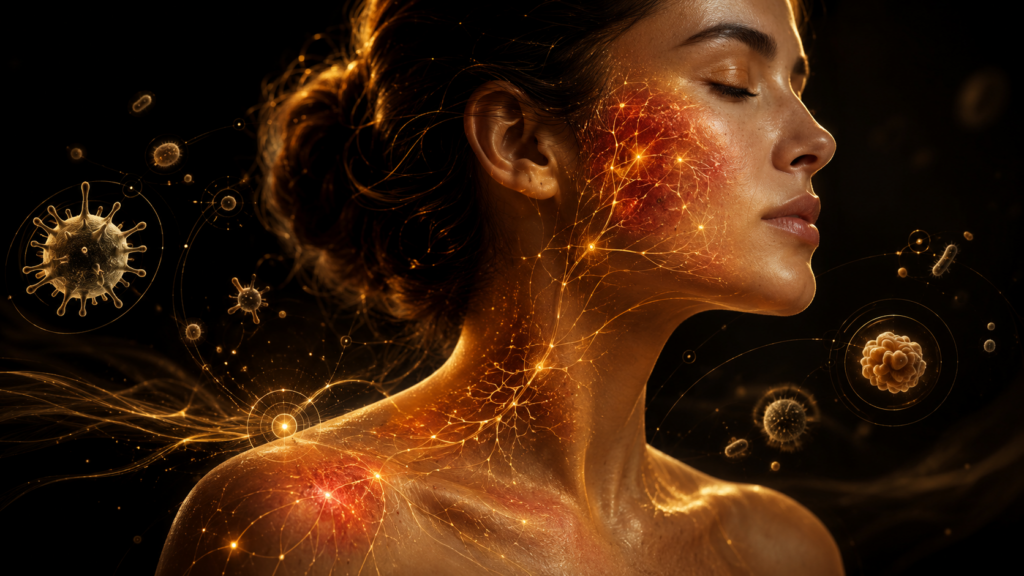
Inflammation is one of the body’s most important protective responses. It helps defend against injury, infection, irritation, and other potential threats. Without it, wounds would not heal properly, harmful microorganisms would be harder to control, and damaged tissue would struggle to recover.
But inflammation does not always remain hidden beneath the surface.
On the skin, it can become visible as redness, swelling, heat, itching, tenderness, dryness, breakouts, or recurring flare-ups. Sometimes the cause is obvious, such as a reaction to a new product, an insect bite, or too much sun. Other times, the skin seems to become inflamed without a clear explanation.
Because the skin is closely connected to the immune system, nervous system, hormones, microbiome, and environment, inflammation can appear for many reasons. What shows up on the outside may reflect a local response at the skin’s surface, a broader change occurring within the body, or several overlapping influences at once.
Understanding inflammation begins with recognizing that it is not simply a symptom to erase. It is a biological process designed to protect, signal, and repair.
What Inflammation Is Designed to Do
Inflammation is the body’s coordinated response to something it identifies as harmful or disruptive. When skin cells detect injury, irritation, allergens, infection, or barrier damage, they release chemical messengers that alert nearby immune cells and blood vessels.
Blood flow to the area may increase. Immune cells may move into the tissue. Fluid may collect around the affected area. Nerve endings may become more sensitive, producing pain, burning, or itching.
These changes help create the conditions needed for protection and repair.
Redness may appear because blood vessels have expanded. Swelling may develop as fluid and immune activity increase. Tenderness may encourage us to protect an injured area. Itching may draw attention to a potential irritant, allergen, or disruption.
In the short term, this response can be useful. It helps contain threats and begin recovery.
Problems are more likely to develop when inflammation becomes excessive, prolonged, repeatedly triggered, or unable to fully resolve.
Acute Inflammation Versus Ongoing Inflammation
Not all inflammation is the same.
Acute inflammation usually develops quickly and has a clear purpose. A scraped knee becomes red and tender. A mosquito bite swells and itches. Sunburn causes heat and discomfort. Once the trigger has passed and the tissue has healed, the inflammatory response should begin to settle.
Chronic or recurring inflammation behaves differently. It may continue for weeks, months, or longer. It may improve and then return. The original trigger may be ongoing, difficult to identify, or connected to several factors at once.
Persistent inflammation can interfere with the skin’s ability to maintain its barrier, regulate moisture, and recover from everyday exposure. As the skin becomes more vulnerable, it may also become more reactive, creating a cycle in which inflammation and barrier disruption reinforce one another.
This does not mean that every lasting skin concern is caused by chronic inflammation. It does mean that inflammation is often one part of a larger pattern.
How Inflammation Appears on the Skin
Skin inflammation does not have one universal appearance. It can look and feel different depending on the cause, the area of the body, a person’s skin tone, and the systems involved.
Common signs may include:
- Redness, warmth, or visible flushing
- Swelling or puffiness
- Itching, burning, or stinging
- Dryness, flaking, or cracking
- Tenderness or pain
- Raised bumps, welts, or rashes
- Breakouts or inflamed follicles
- Changes in pigmentation after the inflammation resolves
- Skin that feels unusually reactive or slow to recover
On deeper skin tones, inflammation may not always appear bright red. It may look purple, gray, brown, or darker than the surrounding skin. In some cases, changes in texture, warmth, swelling, or discomfort may be more noticeable than color alone.
Because inflammation has many possible causes, appearance is only one part of the picture. Timing, location, sensation, and pattern all matter.
When the Skin Barrier Becomes Involved
The skin barrier helps keep moisture in and irritants out. When it becomes disrupted, the skin loses water more easily and becomes less effective at controlling what enters the tissue beneath it.
This can make the immune system more likely to encounter substances it would normally remain separated from, increasing the chance of irritation or inflammation.
At the same time, inflammation can weaken the barrier by changing the way skin cells produce lipids, proteins, and other components needed for repair. This creates a two-way relationship.
A damaged barrier can increase inflammation, and inflammation can make the barrier harder to restore.
The result may be skin that feels tight, dry, itchy, tender, or reactive. Products that once felt comfortable may begin to sting. Environmental exposure may become harder to tolerate. Even water, sweat, or friction may feel irritating.
In these situations, adding more active ingredients is not always the answer. Sometimes the skin needs fewer inputs, greater protection, and enough time to rebuild.
Irritation and Allergy Are Not the Same
Inflamed skin is often described broadly as a reaction, but not every reaction is caused by an allergy.
Irritant contact dermatitis occurs when a substance or repeated exposure directly damages the skin. Strong cleansers, acids, solvents, detergents, frequent handwashing, friction, and harsh weather can all contribute. Almost anyone can develop irritation if the exposure is intense or frequent enough.
Allergic contact dermatitis involves the immune system recognizing a specific substance as a threat. Common triggers may include fragrance compounds, preservatives, metals, adhesives, dyes, and certain botanical ingredients.
The two can look very similar. Both may cause redness, itching, dryness, swelling, or blistering. However, they arise through different mechanisms and may require different forms of evaluation.
Repeatedly exposing inflamed skin to the suspected trigger can make the reaction worse, even when the amount used is small.
This is one reason it can be helpful to simplify products and track what was introduced before the symptoms began.
The Role of the Skin Microbiome
The skin microbiome helps shape immune activity at the surface. In a balanced environment, microorganisms coexist with the skin and contribute to its protective ecosystem.
When the barrier is disrupted or the local environment changes, certain organisms may become more dominant while others decline. This does not automatically mean that the skin is infected, but it may influence inflammation, sensitivity, and recovery.
Conditions such as excessive dryness, heavy oil production, altered pH, over-cleansing, occlusion, sweat, and repeated antibiotic exposure can all change the microbial environment.
The immune system responds not only to individual microorganisms, but also to shifts in the relationships between them.
This helps explain why inflammation is often not simply the result of one harmful organism. It may reflect a broader disturbance in the conditions that normally keep the skin and its microbial community in balance.
Stress, Nerves, and Inflammatory Signaling
The skin and nervous system communicate constantly. Stress can influence this relationship through hormones, neuropeptides, immune activity, and changes in blood flow.
During prolonged stress, the body may become more reactive or slower to recover. Existing skin conditions may flare. Itching may intensify. Sleep disruption may make discomfort feel more severe. People may also scratch, pick, or touch the skin more often without realizing it, creating additional irritation.
This does not mean stress is the sole cause of inflammatory skin concerns. It means stress can alter the environment in which inflammation is occurring.
The nervous system can heighten sensation, while inflammation can make nerves more sensitive. Together, they may create a feedback loop in which itching, burning, or discomfort becomes increasingly difficult to ignore.
Hormonal Changes and Skin Inflammation
Hormones influence oil production, hydration, immune behavior, pigmentation, collagen maintenance, and barrier recovery. When hormonal patterns change, the skin’s inflammatory threshold may change as well.
This can happen during puberty, the menstrual cycle, pregnancy, postpartum changes, perimenopause, menopause, illness, or periods of significant stress.
Some people notice that breakouts, redness, sensitivity, or itching appear at predictable times. Others find that products they tolerated for years suddenly become irritating.
The skin may be responding to the same external environment differently because the internal signaling environment has changed.
Hormones are rarely the only factor, but they can influence how strongly the skin reacts and how quickly it recovers.
When Inflammation Shows Up as Breakouts
Breakouts are often treated as a problem of oil or clogged pores alone, but inflammation is also a central part of the process.
A follicle may become blocked with oil and dead skin cells. Microbial activity may change. The immune system may respond, leading to redness, swelling, tenderness, or pus formation.
This is why aggressive scrubbing and repeated drying can sometimes make breakouts worse. These approaches may remove surface oil temporarily while increasing irritation and damaging the barrier.
Inflamed skin often needs a balance between clearing the follicle and preserving the surrounding tissue.
Not every breakout has the same cause. Hormones, medications, stress, cosmetics, friction, sweat, genetics, and underlying health conditions may all contribute. Patterns such as location, timing, and severity can provide useful clues.
The Aftereffects of Inflammation
Inflammation can leave visible changes even after the original flare has resolved.
Post-inflammatory hyperpigmentation occurs when the skin produces excess pigment after injury or inflammation. This is especially common in deeper skin tones, though it can occur in anyone.
Some people develop lingering redness caused by changes in small blood vessels. Others may notice texture changes, dryness, or increased sensitivity.
The inflammation may be gone, but the skin may still be repairing.
Treating these aftereffects too aggressively can restart the cycle. Strong exfoliation, picking, or frequent procedures may create new inflammation before the skin has fully recovered.
Healing is not always complete when the visible rash, blemish, or irritation begins to fade.
Local Inflammation and Whole-Body Health
Many inflammatory skin concerns begin and remain primarily within the skin. A reaction to a detergent, fragrance, insect bite, or sun exposure does not necessarily point to a larger health problem.
However, the skin can also be influenced by conditions affecting the immune, digestive, endocrine, vascular, or nervous systems.
In some cases, recurring skin inflammation may accompany allergies, autoimmune conditions, infections, medication reactions, hormonal disorders, or other health concerns.
This does not mean that every rash or breakout should be interpreted as evidence of systemic disease. Doing so can create unnecessary fear and confusion.
The more useful approach is to look at the full context. Does the skin change occur with other symptoms? Is it persistent, painful, widespread, or worsening? Does it recur without a clear external trigger? Is it affecting sleep, daily life, or overall well-being?
When the pattern becomes concerning, the skin may be providing information that deserves evaluation beyond skincare alone.
Supporting Inflamed Skin
The right approach depends on the cause, and persistent symptoms should be evaluated by a qualified healthcare professional. However, several general principles can help reduce unnecessary strain while the skin is recovering.
Simplify the Routine
Pause new products and reduce the number of active ingredients being used at once. A simple routine can make it easier to identify potential triggers and give the barrier time to recover.
Cleanse Gently
Use lukewarm water and avoid harsh scrubbing, brushes, or abrasive cloths. Cleansing should remove what needs to be removed without leaving the skin tight or burning.
Protect the Barrier
Choose products that support hydration and reduce water loss. Avoid assuming that peeling, tingling, or stinging means a product is working.
Reduce Friction and Heat
Tight clothing, repetitive rubbing, hot showers, sweat, and overheated environments may worsen certain types of inflammation.
Protect the Skin From Sun Exposure
Inflamed skin may be more vulnerable to ultraviolet damage and post-inflammatory pigmentation. Appropriate sun protection can support recovery.
Avoid Picking and Scratching
This is often easier said than done, especially when the skin is itchy or painful. However, repeated touching can increase injury, inflammation, scarring, and infection risk.
When to Seek Medical Care
Many mild inflammatory reactions improve once the trigger is removed and the barrier is supported. Others require diagnosis and treatment.
Medical evaluation is important when inflammation is severe, rapidly spreading, painful, blistering, infected, or accompanied by fever or other systemic symptoms. Sudden swelling of the face, lips, tongue, or throat requires urgent care.
Persistent rashes, recurring hives, unexplained bruising, non-healing areas, or changes that continue despite a simplified routine should also be assessed.
The appearance of the skin cannot always reveal the cause. A trained clinician may need to consider medical history, medication use, allergies, occupational exposure, hormonal patterns, and other symptoms.
Inflammation Is Information
Inflammation is not a failure of the skin. It is a response.
Sometimes the response is appropriate and temporary. Sometimes it becomes excessive. Sometimes the original trigger remains present, and sometimes the body struggles to fully return to balance.
The visible symptoms may be uncomfortable, frustrating, or difficult to understand, but they are not meaningless.
Redness, itching, swelling, tenderness, dryness, and recurring flare-ups are signs that the skin is responding to its environment. That environment includes not only products and weather, but also the immune system, nervous system, hormones, microbiome, and overall health.
The goal is not simply to force the inflammation out of sight. It is to understand what may be sustaining it, protect the skin while it recovers, and seek appropriate care when the pattern suggests something more.
The skin often speaks through change.
Inflammation is one of its clearest languages.





