

Sleep is one of the most resilient biological processes in the human body.
Even under stress, disruption, and illness, the system will attempt to initiate sleep. It will try to preserve cycles, protect recovery time, and maintain internal restoration.
So when sleep begins to break down—when it becomes difficult to initiate, maintain, or feel restorative—it is rarely a failure of sleep itself.
It is a sign that the systems that regulate sleep have become dysregulated.
Insomnia, fragmented sleep, and unrefreshing sleep are not isolated conditions. They are expressions of broader system imbalance involving the nervous system, circadian timing, metabolic regulation, and immune signaling.
Sleep does not stop working on its own.
Something else is interfering with its ability to complete.
Sleep as a Multi-System Outcome
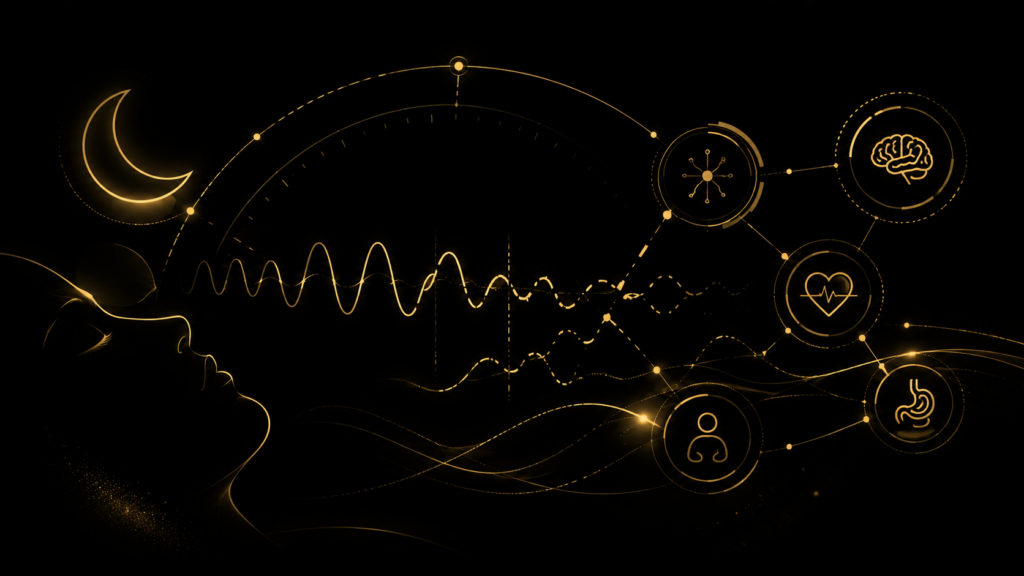
Sleep is not generated by one mechanism. It is the result of coordination between multiple systems:
- the nervous system determines safety and downshift
- the circadian system determines timing
- the endocrine system regulates hormonal transitions
- the immune system adjusts inflammatory activity
- and metabolic systems provide the energy state required for repair
When all of these systems are aligned, sleep emerges naturally.
When one or more are disrupted, sleep becomes unstable.
This is why sleep issues rarely have a single cause. They are usually system-level misalignment patterns.
Insomnia Is Not Absence of Sleep—It Is Presence of Activation
Insomnia is often misunderstood as the inability to sleep.
But biologically, it is more accurately described as the persistence of activation in a state that requires deactivation.
The body is still in a mode of readiness—physically, mentally, or emotionally—even when the environment no longer requires it.
This activation can come from multiple sources:
- cognitive loop activity (unfinished thoughts, processing)
- emotional residue from the day
- physiological stress signaling
- hormonal imbalance affecting circadian timing
- or environmental overstimulation
In insomnia, sleep is not missing. It is being outcompeted by activation signals.
Sleep Fragmentation: When the System Cannot Stay Downshifted
Sleep fragmentation occurs when the body enters sleep but cannot maintain it continuously.
This often results in:
- frequent micro-awakenings
- shallow or unstable sleep cycles
- difficulty returning to deeper sleep stages
- and a sense of “light” or broken sleep
Fragmentation is not random. It reflects a system that is oscillating between sleep and alertness without fully stabilizing in either state.
This can be influenced by:
- nervous system hypervigilance
- environmental disturbances
- metabolic instability (such as blood sugar fluctuations)
- or incomplete circadian alignment
In fragmented sleep, the body is repeatedly attempting to enter recovery states—but those states are not being fully sustained.
The Nervous System Loop That Keeps Sleep “Half-On”
At the core of many sleep disruptions is persistent nervous system activation.
When the sympathetic nervous system remains partially engaged, even during nighttime, the body does not fully transition into restorative states.
Instead, it cycles between:
- partial downshift
- partial reactivation
- shallow sleep entry
- and micro-arousal states
This creates a loop where the body is never fully asleep, but also not fully awake.
It is a hybrid state of incomplete regulation.
This is often experienced as “light sleep that doesn’t feel like sleep.”
Circadian Misalignment: When Timing and Fatigue Don’t Match
Another major driver of sleep failure states is circadian misalignment.
This occurs when the body’s internal timing system no longer matches external behavior patterns.
In this state:
- melatonin may rise too late or too weakly
- cortisol may remain elevated at inappropriate times
- sleep windows may shift later or become inconsistent
- and alertness signals may appear at night
This creates a mismatch between biological readiness for sleep and behavioral attempts to initiate it.
The result is often difficulty falling asleep despite exhaustion, or waking at inconsistent times regardless of sleep duration.
Sleep is present as a need—but absent as a timed event.
The Role of Inflammation in Sleep Disruption
Sleep and inflammation are deeply interconnected systems.
Chronic low-grade inflammation can interfere with sleep regulation by affecting:
- neurotransmitter balance
- hormonal signaling
- and nervous system activation thresholds
When inflammatory signaling remains elevated, the body may experience:
- increased nighttime wakefulness
- reduced deep sleep efficiency
- and non-restorative sleep patterns
This creates a feedback loop:
poor sleep increases inflammation, and inflammation further disrupts sleep.
Over time, this loop can stabilize into a chronic pattern of recovery impairment.
Metabolic Instability and Nighttime Wakefulness
Sleep is metabolically sensitive.
Blood sugar fluctuations, energy instability, or irregular nutrient timing can trigger subtle arousal responses during sleep.
The body is continuously monitoring internal stability, even during rest.
If energy availability becomes unstable, the system may shift toward partial wakefulness to restore balance.
This can manifest as:
- waking in the middle of the night
- difficulty returning to sleep
- or early morning awakenings
These are not always psychological events. They are often metabolic safety responses.
Why Trying Harder to Sleep Often Makes It Worse
One of the most paradoxical aspects of insomnia is that effort can intensify the problem.
Sleep is a state that emerges when regulatory systems shift toward safety, not when control is increased.
When sleep becomes effortful:
- cognitive monitoring increases
- nervous system vigilance rises
- and activation signals are reinforced
This creates a feedback loop where the attempt to force sleep increases the very activation that prevents it.
Sleep cannot be commanded. It must be permitted by system conditions.
Recovery Failure States: When Systems Stop Completing Cycles
At a deeper level, chronic sleep issues often reflect a broader pattern: incomplete recovery cycles across multiple systems.
Instead of:
activation → resolution → restoration
the system begins to operate in:
activation → partial resolution → reactivation → incomplete restoration
This means the body is constantly initiating recovery processes but not fully completing them.
Over time, this leads to:
- reduced sleep depth
- increased sleep fragmentation
- heightened stress sensitivity
- and persistent fatigue despite rest
Sleep becomes not a reset, but a partial pause.
Why Sleep Problems Are Often Multi-System Problems
Sleep is one of the most integrative biological processes in the body.
Because of this, it is highly sensitive to disruption in any one of several systems:
- nervous system regulation
- hormonal timing
- metabolic stability
- immune activity
- environmental conditions
- emotional processing
This is why sleep interventions that target only one pathway often produce limited results.
Sleep is not a single system failure. It is often a coordination failure across multiple systems attempting to regulate together.
The Body Is Still Trying to Sleep
One of the most important truths about sleep disruption is this:
the body does not stop trying to sleep when sleep becomes difficult.
It continues to initiate sleep cycles, regulate hormones, and attempt downshifting—even when those processes are inefficient.
Sleep disorders are not a lack of effort from the body.
They are a reflection of interference with an ongoing biological attempt to restore balance.
This reframes sleep entirely.
It is not absent.
It is struggling to complete itself.
Conclusion: Sleep Failure Is System Overload, Not System Absence
When sleep stops working properly, it is rarely because the sleep system is broken.
It is because the systems that support sleep—nervous, circadian, metabolic, immune, and emotional—are no longer fully aligned.
Insomnia, fragmentation, and non-restorative sleep are not isolated conditions.
They are expressions of a deeper reality:
sleep is a multi-system recovery process that requires coordination to complete.
When that coordination is disrupted, sleep does not disappear.
It becomes incomplete.
And the body continues trying, night after night, to finish what never fully resolves.
Because at its core, sleep is not something the body loses.
It is something the body is still attempting to restore.





