

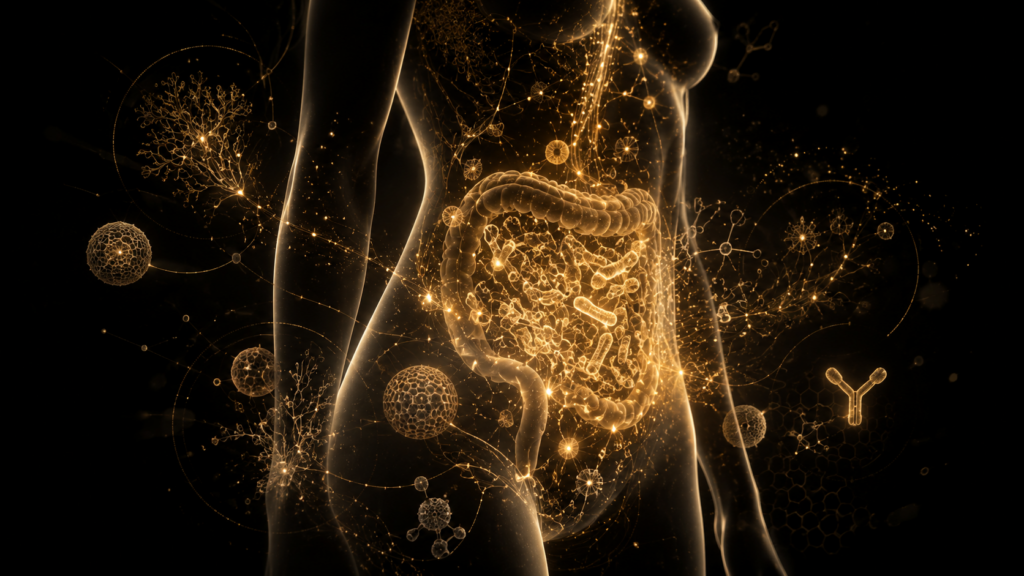
The human microbiome is often described as a collection of bacteria living in the gut. While technically accurate, this definition is too small for what the system actually does.
The microbiome is not a passive population of organisms.
It is a dynamic internal ecosystem that continuously interacts with digestion, immunity, metabolism, hormonal signaling, and even brain function.
It behaves less like a “part of the gut” and more like an embedded regulatory layer within human physiology.
It is not separate from the body.
It is part of how the body functions.
The microbiome as an ecosystem, not a static population
Unlike static organs, the microbiome is constantly shifting. Its composition changes in response to diet, stress, sleep patterns, medication exposure, hormonal changes, and environmental inputs.
This makes it more similar to a rainforest than a single organ system.
Within this ecosystem:
- different microbial species compete for resources
- certain species support inflammatory balance while others amplify it
- metabolic byproducts influence host physiology
- microbial populations respond rapidly to dietary and hormonal signals
Because of this, the microbiome is both highly adaptive and highly sensitive.
It reflects the internal and external environment in real time.
Microbial metabolism and host signaling
One of the most important functions of the microbiome is its ability to metabolize compounds that directly influence human physiology.
Microbial activity contributes to:
- short-chain fatty acid production that regulates inflammation and gut barrier integrity
- bile acid transformation that influences fat digestion and cholesterol metabolism
- neurotransmitter precursor modulation affecting brain signaling pathways
- vitamin synthesis and nutrient bioavailability
These microbial byproducts are not confined to the gut.
They enter systemic circulation and influence distant systems, including the brain, skin, and endocrine network.
This is why the microbiome behaves like a metabolic extension of the human body rather than an isolated environment.
The microbiome and immune system training
A significant portion of the immune system resides in the gut, and it is continuously interacting with the microbiome.
This relationship is not adversarial under normal conditions. It is regulatory.
The immune system uses microbial exposure to calibrate its response thresholds. It learns what is benign, what is potentially harmful, and how strongly to react to different signals.
When this interaction is balanced, immune responses are appropriately measured.
When it is disrupted, immune signaling can become either under-responsive or overactive.
This shift can influence systemic inflammation, skin reactivity, and even neurological sensitivity.
The microbiome is therefore not only influencing digestion.
It is shaping immune system behavior.
The gut-brain communication loop through microbial signaling
The microbiome plays a direct role in gut-brain communication through multiple pathways.
These include:
- vagus nerve signaling influenced by gut microbial activity
- immune cytokines that respond to microbial balance
- microbial metabolites that affect neurotransmitter production
- modulation of stress response pathways through inflammatory signaling
This means microbial composition can influence mood, cognition, stress tolerance, and emotional regulation indirectly but consistently.
The brain is not only responding to psychological input.
It is responding to microbial activity translated through physiological signaling systems.
This is one of the most overlooked layers of brain-body integration.
Microbiome diversity and system resilience
A more diverse microbiome is generally associated with greater system resilience.
Diversity in this context means a wide range of microbial species performing different metabolic and regulatory functions.
When diversity is high, the system tends to be more adaptable to dietary changes, environmental stress, and internal fluctuations.
When diversity is reduced, the system becomes more vulnerable to perturbation.
This does not mean “more bacteria is better.”
It means functional variety improves regulatory stability.
A less diverse ecosystem has fewer backup pathways when conditions change.
Dysbiosis as a signaling imbalance, not just bacterial overgrowth
Dysbiosis refers to an imbalance in microbial composition. It is often misunderstood as simply “bad bacteria overgrowth,” but the concept is more complex.
Dysbiosis can involve:
- reduced microbial diversity
- loss of beneficial metabolic functions
- increased inflammatory signaling
- altered gut barrier permeability
- disrupted communication between microbes and host systems
The result is not just digestive discomfort.
It is altered systemic signaling.
Because the microbiome influences multiple systems simultaneously, dysbiosis can manifest as fatigue, skin changes, mood variability, metabolic instability, or immune sensitivity.
It is a network-level imbalance, not a localized issue.
The microbiome and hormonal interaction
The microbiome also interacts with hormonal systems through what is sometimes referred to as the estrobolome, the collection of gut microbes involved in estrogen metabolism.
Microbial populations can influence how hormones are processed, recycled, or eliminated.
This means the microbiome can indirectly influence:
- hormonal balance
- cycle regularity
- estrogen availability
- systemic inflammatory tone related to hormonal fluctuations
This interaction creates a feedback loop between gut health and endocrine regulation.
Hormones influence the microbiome.
The microbiome influences hormone metabolism.
Neither system operates independently.
The skin as an external reflection of microbial balance
Because microbial metabolites and immune signals circulate systemically, changes in the microbiome often appear externally through the skin.
This can include:
- inflammatory skin responses
- changes in barrier function
- shifts in oil production and hydration balance
- altered sensitivity or reactivity
The skin is not reacting to the microbiome directly.
It is responding to the systemic immune and metabolic signals shaped by microbial activity.
This is why skin health often reflects internal gut balance.
Why microbiome changes feel unpredictable
One of the challenges of working with the microbiome is that changes can feel nonlinear.
Small shifts in diet or stress can produce delayed or disproportionate effects because microbial populations operate on their own internal cycles of adaptation.
Additionally, microbial shifts influence multiple systems at once, which can create overlapping and delayed symptom patterns.
This makes cause-and-effect difficult to trace in real time.
But underneath the variability, the system is still responding to consistent ecological principles.
The microbiome as an adaptive interface
The microbiome is best understood as an adaptive interface between the external environment and internal physiology.
It translates dietary input, environmental exposure, and host signaling into biochemical outputs that influence systemic regulation.
It is both responsive and influential.
It is shaped by the body while simultaneously shaping the body’s responses.
This bidirectional relationship makes it one of the most dynamic systems in human biology.
Conclusion: a living ecosystem inside the body
The microbiome is not a passive collection of organisms.
It is a living, adaptive ecosystem that participates directly in human physiology.
It influences digestion, immunity, metabolism, hormonal regulation, and neurological function through continuous biochemical signaling.
When viewed through this lens, health is no longer about isolated systems functioning independently.
It becomes about ecological balance within an internal environment that is constantly interacting with external inputs.
The microbiome is not separate from human health.
It is one of the primary ways human health is regulated.





