

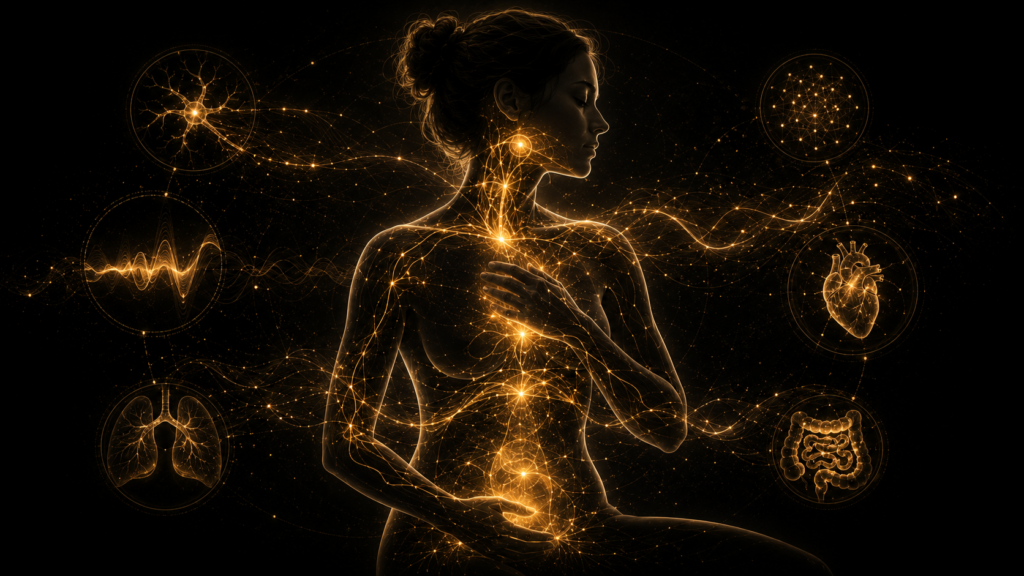
Emotions are often treated as psychological events, occurring in the mind and expressed through behavior. While this is partly true, it is incomplete in a way that hides what is happening physiologically.
Emotions are not only mental experiences.
They are whole-body regulatory states.
Each emotional experience involves coordinated changes across the nervous system, endocrine system, cardiovascular system, respiratory patterns, and muscular tone. Emotion is not confined to thought. It is distributed through physiology.
This means emotional load is not just something the mind carries.
It is something the body continuously regulates.
Emotion as a physiological state, not just a feeling
At the biological level, emotions are patterns of activation and regulation across multiple systems.
Fear is not only a thought process. It involves increased sympathetic nervous system activity, changes in heart rate, altered breathing patterns, and shifts in hormonal signaling such as cortisol and adrenaline.
Sadness is not only cognitive interpretation. It often involves reduced energy output, altered inflammatory signaling, and changes in motor tone and motivation pathways.
Anger involves mobilization of energy, increased cardiovascular activation, and heightened readiness states across multiple systems.
These patterns are not symbolic.
They are physiological configurations.
Emotion is the body entering a coordinated state of response.
What happens when emotional responses are not completed
Emotional experiences are designed to move through a cycle:
activation → processing → resolution → return to baseline
When this cycle completes, the body returns to regulatory balance.
But emotional experiences are not always fully processed in real time. When expression is suppressed, interrupted, or not fully integrated, the physiological activation does not always resolve completely.
Instead, elements of that state can remain partially active within the system.
This does not mean emotions are “stored” like static objects.
It means the physiological signature of an emotional state can remain partially unresolved.
Over time, this contributes to cumulative regulatory load.
The nervous system as the primary emotional processing layer
The nervous system is the central integrator of emotional experience.
It determines how strongly a stimulus is interpreted, how long a response is sustained, and how fully the system returns to baseline afterward.
When the nervous system is flexible and well-regulated, emotional states can move through the body efficiently.
When the nervous system is under chronic stress or dysregulation, emotional transitions can become less complete.
This can result in:
- prolonged emotional activation states
- reduced ability to downshift after stress
- increased baseline sensitivity to stimuli
- difficulty returning to neutral physiological state
In this context, emotional load accumulates not as memory, but as incomplete resolution of physiological states.
The body does not separate emotional and physical load
One of the most important principles in emotional physiology is that the body does not distinguish between emotional stress and physical stress at the level of regulatory response.
Both activate overlapping systems:
- sympathetic nervous system activation
- cortisol and adrenaline release
- immune and inflammatory signaling
- muscular tension patterns
- respiratory and cardiovascular changes
Because these systems are shared, emotional experiences can produce physical patterns, and physical stress can influence emotional regulation.
The system treats both as variations of demand on overall regulatory capacity.
Muscular tone and emotional residue
One of the most visible ways emotional load expresses physically is through muscular tension patterns.
The body often holds residual activation in muscle groups associated with protective or preparatory responses.
This is not symbolic “storage of emotion in specific body parts.”
It is the persistence of physiological readiness states in certain muscle groups that were activated during emotional or stress responses.
Common areas of sustained tension may include:
- jaw and facial muscles
- neck and shoulders
- chest and diaphragm
- abdominal and pelvic regions
These patterns reflect repeated activation without full deactivation cycles.
The body is not “holding emotion” in a metaphorical sense.
It is maintaining partial readiness states in motor systems.
Breath as a reflection of emotional regulation
Breathing patterns are one of the most direct indicators of emotional state.
Because respiration is both automatic and modifiable, it sits at the intersection of conscious and unconscious regulation.
During emotional activation, breathing often becomes shallow, rapid, or high in the chest. During regulated states, breathing tends to deepen and shift toward diaphragmatic patterns.
When emotional load is chronic or unresolved, breathing patterns may become less flexible, defaulting toward partial activation states even in neutral conditions.
This reflects ongoing nervous system engagement.
Breath becomes a real-time indicator of emotional regulatory capacity.
Why emotional load feels cumulative over time
Emotional experiences do not simply disappear after they occur. The body continuously integrates, resolves, or carries forward physiological patterns based on whether activation cycles are completed.
When emotional experiences are frequent, intense, or not fully processed, the system may begin to accumulate overlapping regulatory demands.
This can create a sense of emotional heaviness or fatigue that is not tied to a single event.
It is not that emotions are stacking like objects.
It is that multiple incomplete regulatory cycles are active within the system at once.
This increases baseline load on nervous system regulation.
The difference between emotional expression and emotional processing
Emotional expression is the outward release of internal state through behavior, communication, or physical response.
Emotional processing is the internal physiological integration and resolution of that state.
These are not always synchronized.
It is possible to express emotion without fully processing it, and it is also possible to process emotion internally without external expression.
When expression occurs without processing, the physiological load may remain active.
When processing occurs effectively, the system returns to baseline more completely.
This distinction is critical in understanding emotional physiology.
The body as a continuous regulatory system
The body is not a container that stores emotions.
It is a continuous regulatory system that responds to emotional input in real time.
Emotions arise, are processed through physiological systems, and either resolve or remain partially active depending on system capacity, context, and support.
Over time, this creates patterns of regulation that influence baseline nervous system tone, stress sensitivity, and emotional responsiveness.
Emotional life is therefore not separate from physiology.
It is one of the ways physiology organizes experience.
Conclusion: emotional load is regulatory load
Emotional experiences are not abstract events separate from the body.
They are full-system physiological states that require regulation, integration, and resolution.
When these processes complete efficiently, emotional experiences move through the body and resolve without long-term residual load.
When they do not, elements of those physiological states can remain partially active, contributing to cumulative regulatory demand.
The body does not store emotion as memory in a fixed location.
It carries emotional experience as patterns of regulation that are either completed or left partially unresolved.
Emotional load, then, is not about how much someone feels.
It is about how fully the body is able to process what is felt.





