

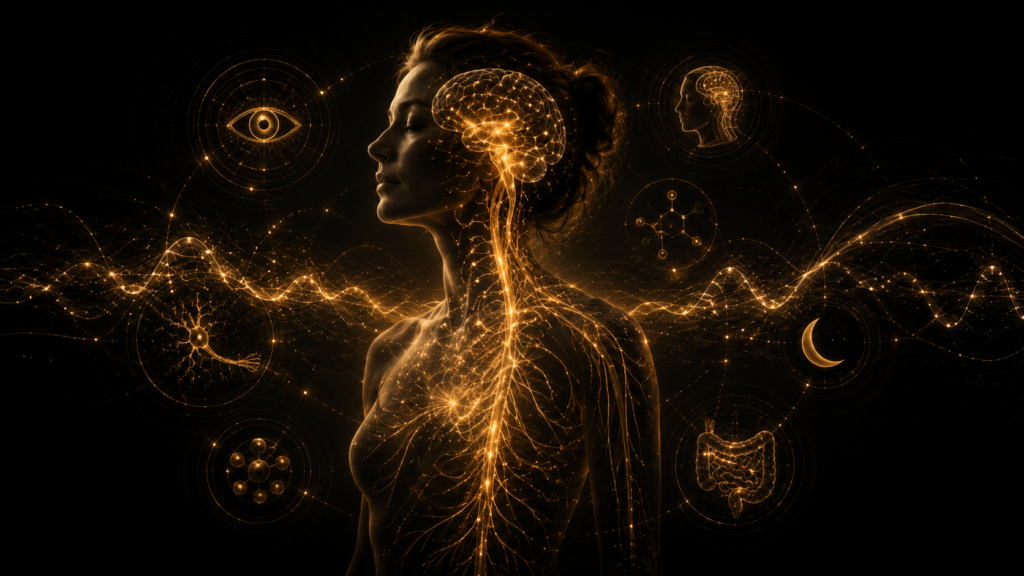
Trauma is often described as a psychological memory of a painful event. While memory is part of the experience, trauma is not only something remembered by the mind.
It is something adapted to by the body.
At the physiological level, trauma is not defined solely by what happened. It is defined by how the nervous system reorganized itself in response to overwhelming stress, threat, helplessness, or prolonged instability.
This is why trauma can continue affecting the body long after the original event has passed.
The event may be over.
But the physiological adaptation to the event may still be active.
Trauma is a nervous system survival response
The nervous system is designed to detect threat and coordinate survival responses automatically.
When danger is perceived, the body shifts into protective states involving:
- increased sympathetic nervous system activation
- cortisol and adrenaline release
- heightened vigilance and sensory monitoring
- muscular preparation for action
- redistribution of energy toward immediate survival
Under normal circumstances, once danger passes, the nervous system gradually returns to baseline regulation.
Trauma occurs when this process does not fully resolve.
Instead of completing the cycle of activation and return, parts of the survival response remain physiologically active.
This creates a body that continues preparing for a threat that is no longer present.
The body learns through repetition and intensity
The nervous system is constantly learning patterns from experience.
Repeated stress exposure, chronic unpredictability, or highly intense events can reshape how the nervous system interprets safety and danger moving forward.
This learning process is adaptive in the short term.
If an environment is unstable, the body increases vigilance to improve survival probability. If threat is repeated, the nervous system lowers the threshold for detecting future danger.
Over time, these adaptations can become persistent regulatory patterns.
The body begins operating as though threat is likely even in objectively safe conditions.
This is not irrationality.
It is conditioned survival physiology.
Trauma is stored as pattern, not narrative
One of the most important distinctions in trauma physiology is that the body does not store traumatic experience primarily as verbal story.
It stores it as physiological pattern.
This includes:
- autonomic nervous system conditioning
- muscular guarding and tension patterns
- altered stress hormone regulation
- heightened sensory responsiveness
- changes in breathing and cardiovascular patterns
This is why trauma responses are often triggered before conscious thought fully interprets what is happening.
The body recognizes pattern first.
The mind explains afterward.
Hypervigilance: when the nervous system cannot fully stand down
One of the most common physiological consequences of trauma is hypervigilance.
In this state, the nervous system remains partially oriented toward threat detection even during periods of relative safety.
This can manifest as:
- heightened sensitivity to sound, tone, or environmental shifts
- difficulty fully relaxing or “letting go”
- increased startle responses
- persistent muscular tension
- exhaustion paired with inability to fully rest
The body is not consciously choosing this state.
It is operating from learned survival expectation.
The nervous system has adapted to prioritize detection over restoration.
Trauma changes baseline regulation
Trauma does not only affect reactions to stress.
It can alter baseline physiological regulation itself.
Over time, chronic survival activation can influence:
- sleep architecture and recovery quality
- cortisol timing and hormonal regulation
- inflammatory signaling patterns
- digestive function and gut-brain communication
- emotional regulation thresholds
- energy allocation and metabolic stability
This is why trauma is often experienced as a whole-body condition rather than purely an emotional memory.
The body reorganizes around survival efficiency.
The role of incomplete survival responses
Many trauma researchers and clinicians describe trauma as involving incomplete survival responses.
During overwhelming events, the body may initiate defensive patterns that cannot fully complete. Fight, flight, freeze, collapse, or shutdown responses may become interrupted or unresolved.
The nervous system remembers these incomplete states physiologically.
Instead of:
activation → completion → resolution
the system remains in:
activation → interruption → partial persistence
This leaves elements of the response cycle active beneath conscious awareness.
The body is still attempting to finish what it never fully resolved.
Freeze and shutdown states are physiological, not weakness
Not all trauma responses involve visible hyperactivation.
Some involve hypoactivation or shutdown.
In these states, the nervous system reduces output to preserve survival under overwhelming conditions. This may include:
- emotional numbing
- dissociation or disconnection
- reduced energy and motivation
- flattened affect
- difficulty accessing emotional states
These are not failures of character.
They are protective regulatory strategies.
The body is conserving resources and minimizing stimulation in response to perceived overwhelm.
Shutdown is not absence of response.
It is a survival response itself.
Why trauma responses can feel irrational
Trauma responses often feel disproportionate because they are based on physiological prediction, not present-moment logic.
The nervous system prioritizes survival speed over conscious analysis.
If a current experience resembles a previously threatening pattern, the body may activate protective responses automatically before the conscious mind determines whether danger is truly present.
This is why seemingly small triggers can produce intense reactions.
The nervous system is not responding to the current event alone.
It is responding to historical pattern recognition.
The gut, immune system, and trauma physiology
Trauma affects more than the nervous system.
Chronic stress activation influences gut function, microbiome balance, and immune signaling through continuous communication between the brain and body.
This can contribute to:
- digestive disruption
- inflammatory dysregulation
- altered appetite and metabolic patterns
- increased physical sensitivity to stress
Because the nervous system and immune system are deeply interconnected, unresolved survival activation can create long-term physiological ripple effects far beyond emotional experience.
Trauma becomes systemic.
Healing is not erasing memory, it is restoring regulation
One of the most important reframes in trauma physiology is that healing does not require erasing the past.
The nervous system cannot undo experience.
What it can do is update regulation.
Healing involves helping the body learn that activation no longer needs to remain chronically sustained. It involves increasing nervous system flexibility, improving recovery capacity, and restoring the ability to distinguish present safety from past threat.
This is not about forgetting.
It is about reducing the physiological necessity of continued survival activation.
Safety is physiological, not just intellectual
Trauma work often becomes difficult because intellectual understanding alone does not immediately change nervous system behavior.
The body requires physiological experiences of safety, predictability, and successful regulation in order to update survival patterns.
This is why practices that support nervous system regulation, sleep stability, breath regulation, emotional processing, movement, and social safety can influence trauma recovery at a biological level.
The nervous system learns through embodied experience.
Not only through thought.
Conclusion: the body carries adaptation, not weakness
Trauma is not evidence that the body failed.
It is evidence that the body adapted.
The nervous system changed its thresholds, predictions, and regulatory patterns in order to improve survival under overwhelming conditions. Those adaptations may later become limiting, exhausting, or disruptive, but they originated as protective responses.
The past lives in the present body not because the body refuses to move on, but because physiology is designed to remember what once threatened survival.
Healing, then, is not about forcing the body to forget.
It is about helping the body recognize that survival no longer requires the same level of protection.
The body is not broken.
It is still responding to a world it once had to survive.