

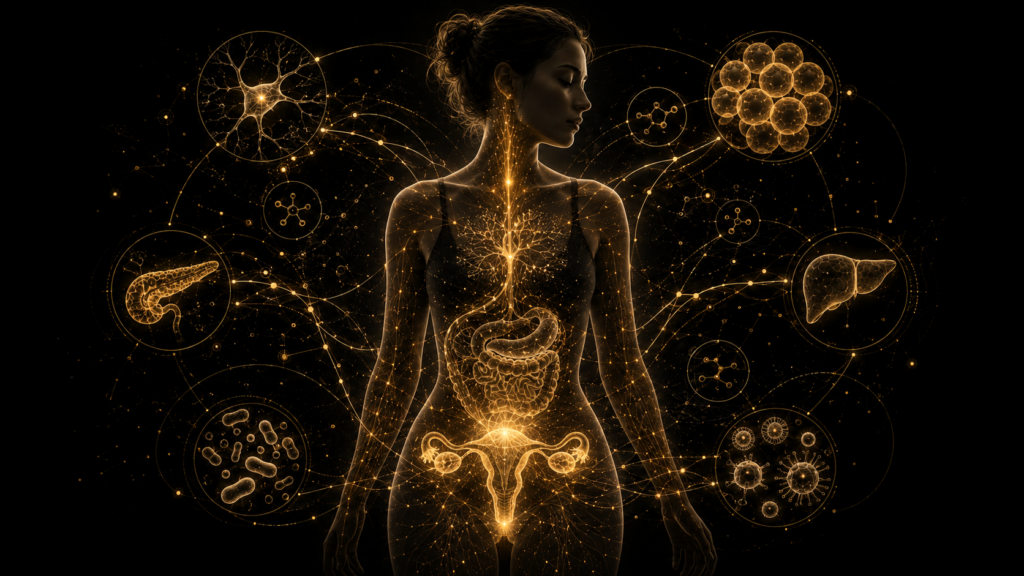
Polycystic Ovary Syndrome, commonly known as PCOS, is often described as a reproductive disorder involving irregular periods, ovarian cysts, and fertility challenges.
While these symptoms are real, they represent only part of the picture.
PCOS is not simply an ovarian condition.
It is a whole-body regulatory condition involving metabolism, insulin signaling, inflammation, hormonal communication, and nervous system regulation.
The ovaries are often where symptoms become visible, but they are not necessarily where the story begins.
This distinction matters because many women spend years focusing exclusively on reproductive symptoms while the deeper metabolic and inflammatory drivers remain largely unaddressed.
To understand PCOS, we must move beyond the ovaries themselves and begin looking at the larger network of systems influencing them.
PCOS is not simply a reproductive diagnosis.
It is a systems biology diagnosis.
Why PCOS Is More Than a Reproductive Condition
For many years, PCOS was primarily viewed through a gynecological lens.
Symptoms such as:
- irregular menstrual cycles
- absent ovulation
- infertility
- ovarian cysts
- elevated androgens
became the primary focus of diagnosis and treatment.
But over time, researchers began noticing something important.
Many women with PCOS also experienced:
- insulin resistance
- weight regulation challenges
- increased inflammation
- blood sugar instability
- cardiovascular risk factors
- metabolic dysfunction
These patterns suggested that the condition extended far beyond reproductive tissues.
The ovaries were participating in the condition, but they were not acting independently.
They were responding to signals originating throughout the body.
The Central Role of Insulin
One of the most important physiological drivers of PCOS is insulin.
Most people think of insulin as a blood sugar hormone.
In reality, insulin is also a powerful signaling molecule that influences metabolism, inflammation, energy allocation, and reproductive function.
When food is consumed, insulin helps move glucose from the bloodstream into cells where it can be used for energy or stored for future use.
In healthy physiology, this process occurs efficiently.
But when cells become less responsive to insulin, the body compensates by producing more of it.
This state is known as insulin resistance.
And it is one of the most common physiological patterns observed in PCOS.
How Insulin Affects the Ovaries
The relationship between insulin and reproductive hormones is often overlooked.
The ovaries contain insulin receptors and respond directly to insulin signaling.
When insulin levels remain chronically elevated, ovarian hormone production can change.
In many cases, increased insulin signaling stimulates the ovaries to produce greater amounts of androgens, including testosterone.
This can contribute to symptoms such as:
- irregular ovulation
- absent ovulation
- acne
- unwanted hair growth
- scalp hair thinning
- cycle disruption
This is why PCOS is not simply an ovarian disorder.
The ovaries are responding to metabolic signals coming from elsewhere in the body.
In many cases, insulin is acting as one of the primary messengers driving the process.
Insulin Resistance Is Not Just a Blood Sugar Problem
One of the most common misunderstandings about insulin resistance is that it only affects glucose levels.
In reality, insulin resistance influences nearly every major regulatory system.
It affects:
- energy production
- fat storage
- hunger signaling
- inflammatory activity
- hormone production
- cardiovascular function
Over time, the body becomes less efficient at switching between fuel sources and regulating energy availability.
This can contribute to:
- energy crashes
- intense cravings
- difficulty maintaining stable energy
- increased fat storage
- chronic fatigue
- disrupted hormonal rhythm
These symptoms often appear alongside reproductive symptoms because they share common physiological roots.
Inflammation: The Overlooked Driver
Inflammation is another major player in PCOS physiology.
Inflammation itself is not inherently harmful.
It is one of the body’s primary communication and repair systems.
Problems arise when inflammatory signaling becomes chronic.
In women with PCOS, researchers have observed increased levels of low-grade systemic inflammation even when no obvious illness is present.
This chronic inflammatory environment can influence:
- insulin sensitivity
- ovarian hormone production
- stress hormone regulation
- tissue responsiveness
- metabolic flexibility
Over time, inflammation and insulin resistance begin reinforcing each other.
Higher inflammation can worsen insulin resistance.
Worsened insulin resistance can further increase inflammatory signaling.
A feedback loop develops.
And once established, this loop can become difficult to interrupt.
The Nervous System Connection
PCOS is not only metabolic and inflammatory.
It is also neurological.
The nervous system plays a significant role in regulating hormonal communication.
Chronic stress activation influences:
- cortisol production
- blood sugar regulation
- insulin sensitivity
- inflammatory signaling
- reproductive hormone timing
When the body remains in a prolonged state of stress physiology, it becomes more difficult to maintain hormonal coordination.
This does not mean stress causes PCOS.
But it does mean stress physiology can influence how PCOS is experienced.
The nervous system is part of the equation.
Just as the ovaries respond to metabolic signals, they also respond to the broader stress environment within the body.
Why Symptoms Can Look So Different Between Women
One of the reasons PCOS can be frustrating is that it does not present the same way in every individual.
Some women primarily experience reproductive symptoms.
Others experience metabolic symptoms.
Others struggle with inflammation, fatigue, mood changes, or skin issues.
This variation exists because PCOS is not a single-pathway condition.
It is a systems-level condition.
Different regulatory networks may be more affected in different individuals.
For example:
One woman may experience significant insulin resistance but relatively mild reproductive symptoms.
Another may have severe cycle disruption despite relatively stable metabolic markers.
A third may primarily struggle with inflammatory symptoms such as fatigue and chronic discomfort.
The diagnosis may be the same.
The physiology underneath can be very different.
PCOS and the Gut-Metabolism Connection
Emerging research is increasingly exploring the role of the gut microbiome in PCOS.
The microbiome influences:
- insulin sensitivity
- inflammation
- estrogen metabolism
- nutrient absorption
- immune regulation
Changes in microbial diversity and gut barrier function may contribute to the inflammatory and metabolic patterns commonly observed in PCOS.
This does not mean the microbiome is the sole cause.
But it reinforces a broader theme seen throughout human physiology:
No system operates alone.
The reproductive system, metabolic system, immune system, and gut environment continuously influence one another.
Why Weight Is Often Misunderstood in PCOS
Weight is frequently discussed in conversations about PCOS, but often in ways that oversimplify the physiology.
Many women with PCOS are told their symptoms exist because of excess weight.
In reality, the relationship is often more complex.
Insulin resistance itself can influence:
- hunger signaling
- fat storage patterns
- energy availability
- metabolic flexibility
In other words, metabolic dysfunction may contribute to weight changes rather than weight being the sole driver of metabolic dysfunction.
This distinction is important.
It shifts the conversation away from blame and toward biology.
The body is responding to regulatory signals, not simply personal choices.
PCOS as a Communication Problem
A useful way to think about PCOS is as a communication disorder between systems.
The ovaries are communicating with the brain.
The brain is communicating with the adrenal glands.
The metabolic system is communicating through insulin.
The immune system is communicating through inflammatory signaling.
The nervous system is interpreting environmental stress.
When these signals become dysregulated, coordination suffers.
The result appears as reproductive dysfunction.
But underneath, multiple systems are struggling to synchronize.
PCOS is not simply a hormone problem.
It is a signaling problem.
Moving Beyond Symptom Management
Traditional treatment approaches often focus on individual symptoms.
Periods become the focus.
Or fertility.
Or acne.
Or weight.
While symptom management can be valuable, understanding the broader physiology allows for a more complete picture.
Because beneath the visible symptoms are larger questions:
How is insulin functioning?
What is inflammation communicating?
How resilient is the nervous system?
How stable is metabolic regulation?
How coordinated is hormonal signaling?
These questions often reveal far more about the condition than reproductive symptoms alone.
Conclusion: The Ovaries Are Part of the Story, Not the Whole Story
PCOS is commonly diagnosed through reproductive symptoms, but its roots extend far beyond the reproductive system.
Insulin signaling influences ovarian behavior.
Inflammation shapes metabolic and hormonal regulation.
The nervous system affects stress physiology and endocrine communication.
The gut contributes to immune and metabolic balance.
Together, these systems create the environment in which the ovaries operate.
Understanding PCOS through this broader lens changes the conversation entirely.
The ovaries are not malfunctioning in isolation.
They are responding to a network of signals originating throughout the body.
And when PCOS is viewed as a systems condition rather than simply a reproductive disorder, the condition begins to make much more sense.
Because the story of PCOS is not only about ovaries.
It is about communication across the entire body.





