

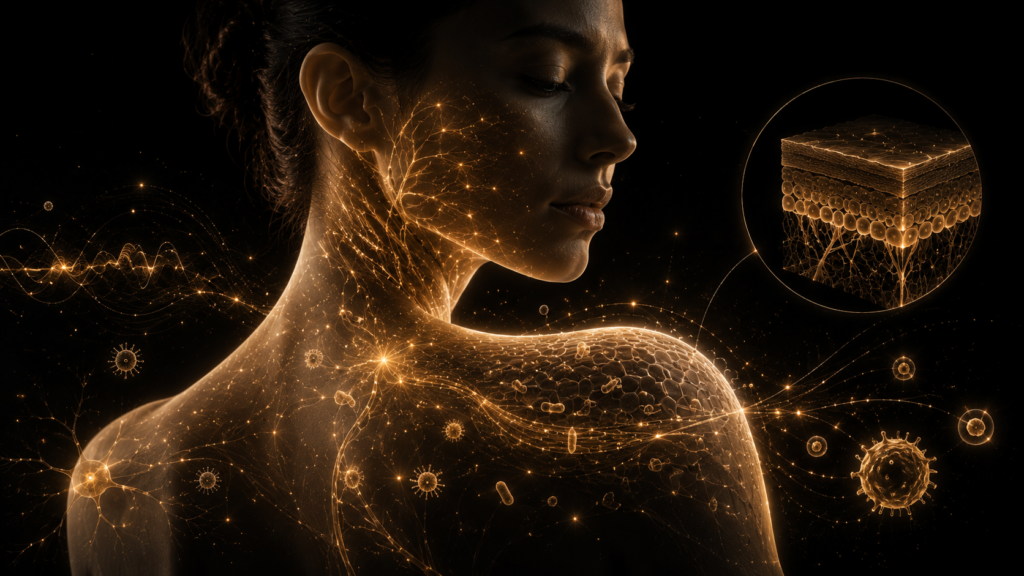
Most conversations about skin begin with appearance. We notice whether it is clear, smooth, dry, oily, red, sensitive, uneven, or beginning to show signs of age. Because the skin is visible in a way most organs are not, it is easy to think of it primarily as something to examine, improve, conceal, or correct.
But appearance tells only part of the story.
The skin is continuously receiving information from both inside and outside the body. It senses temperature, pressure, pain, touch, light, injury, microbes, environmental irritants, hormonal changes, and stress signals. It participates in immune defense, supports temperature regulation, communicates with the nervous system, and helps coordinate the body’s response to the surrounding world.
The skin is not simply a covering placed around the body. It is a living, responsive signaling organ, and understanding it this way can change how we interpret everything from dryness and sensitivity to inflammation, breakouts, and recurring flare-ups.
A Living Boundary Between the Body and the World
The skin occupies a unique biological position. It belongs to the internal body, yet it remains in constant contact with the external environment. Every day, it encounters changes in temperature and humidity, ultraviolet radiation, microorganisms, allergens, friction, pressure, pollution, topical products, and physical injury.
Its job is not merely to block these exposures. The skin must interpret them and determine how the body should respond.
Some of those responses happen almost immediately. Blood vessels expand to help release heat. Sweat glands activate to cool the body. Sensory nerves alert us to pain, pressure, or temperature. Immune cells respond when tissue has been damaged or when a potential threat has crossed the barrier.
Other responses develop more gradually. Pigment production may increase after sun exposure. Barrier repair processes may begin after irritation. Oil production, hydration, inflammation, sensitivity, and cellular turnover may shift over time.
These changes are not random. They are part of the skin’s ongoing communication with the body.
The Skin Is Constantly Receiving Information
The outer layer of the skin was once viewed primarily as a passive wall made of structural cells. We now understand that many of those cells are biologically active and capable of detecting changes in their environment.
Keratinocytes, the primary cells found in the epidermis, help form the physical skin barrier. They also respond to heat, cold, pressure, ultraviolet radiation, changes in acidity, microbial activity, chemical irritation, and tissue damage. When they detect disruption, they can release chemical messengers that influence nearby immune cells, sensory nerves, blood vessels, and other skin cells.
Depending on the situation, these messages may help initiate repair, increase inflammation, recruit immune support, or heighten sensations such as itching, burning, tenderness, or discomfort.
This means the cells at the surface are not simply waiting to be damaged or protected. They are actively gathering information and helping determine what happens next.
A Network of Cells Working Together
The skin contains many different kinds of cells and structures, each with a distinct role. Keratinocytes support the outer barrier. Melanocytes produce pigment and help protect against ultraviolet exposure. Fibroblasts produce structural components such as collagen and elastin. Immune cells monitor for injury, infection, and environmental threats. Sensory nerves detect pain, temperature, pressure, and itch.
The skin also contains blood vessels, hair follicles, sweat glands, and sebaceous glands. Together, these structures help regulate temperature, hydration, sensation, oil production, wound healing, and immune activity.
They do not perform these functions in isolation. They communicate through a complex network of hormones, cytokines, neuropeptides, growth factors, electrical impulses, and other signaling molecules.
Skin health is therefore not the result of one cell, one product, or one process. It emerges from the coordination of an entire biological community.
The Connection Between the Skin and Nervous System
The relationship between the skin and the nervous system is especially significant. Sensory nerve endings extend throughout the skin, allowing the body to detect what is happening at its outer boundary.
They alert us when something is hot, cold, sharp, painful, or irritating. They help us respond to pressure and touch. They create the sensation of itching when the skin or immune system detects a possible problem.
However, communication does not travel in only one direction. Nerves can also release signaling molecules into the skin, influencing blood flow, inflammation, immune behavior, sensation, and barrier function. At the same time, skin cells can release substances that activate or calm nearby nerve endings.
This two-way exchange helps explain why inflamed or disrupted skin may burn, sting, itch, or feel painful even when there is no visible wound. The sensation is not necessarily an overreaction. It may be part of the communication taking place between the skin and nervous system.
Why Stress Can Become Visible on the Skin
Many people notice that their skin changes during periods of emotional strain, poor sleep, illness, grief, or prolonged pressure. A manageable condition may suddenly flare. Sensitivity may increase. Breakouts may become more frequent. Itching may intensify, and healing may seem slower.
These experiences are not imaginary, nor are they merely cosmetic.
Stress activates pathways involving the nervous, endocrine, and immune systems. Hormones and signaling molecules associated with the stress response can influence inflammation, circulation, oil production, immune activity, wound healing, and the skin’s ability to restore its barrier.
The skin also contains local signaling systems that can produce and respond to some of the same chemical messengers involved in the body’s broader stress response. This allows the skin to participate directly in the way stress is experienced throughout the body.
Not every skin condition is caused by stress, and stress should not be used as a vague explanation when a person needs proper medical evaluation. However, the skin does not experience stress separately from the rest of the body. It responds within the same biological environment.
The Skin as Part of the Immune System
The skin is one of the body’s largest areas of immune surveillance. Because it remains in constant contact with the outside world, it must distinguish between harmless exposure and genuine danger.
This is a delicate balancing act. The immune system must remain alert enough to respond to injury, harmful microorganisms, allergens, and environmental threats. At the same time, it must avoid launching an excessive response to every substance that touches the skin.
When this balance is disrupted, immune activity may become visible as:
- Redness or warmth
- Swelling or tenderness
- Dryness and flaking
- Itching or burning
- Increased sensitivity
- Recurring rashes or flare-ups
- Slow or incomplete recovery
These symptoms are not the immune response itself. They are the outward signs of communication and activity taking place within the tissue.
Inflammation is not inherently harmful. It is a protective process designed to contain threats, remove damaged material, and begin repair. Problems can develop when inflammation becomes excessive, persistent, poorly regulated, or repeatedly triggered without enough time for recovery.
The Skin Microbiome Joins the Conversation
The surface of the skin is home to communities of bacteria, fungi, viruses, and other microorganisms collectively known as the skin microbiome. These organisms are not simply passengers resting on the body. They interact with skin cells, immune pathways, natural oils, environmental conditions, and one another.
A balanced microbial community can help discourage the overgrowth of potentially harmful organisms and support healthy immune behavior. Some microorganisms also help maintain the mildly acidic conditions that support barrier function.
The skin, in turn, creates the environment in which these organisms live. Moisture, oil production, temperature, pH, oxygen exposure, and the location on the body all influence which microorganisms are most likely to thrive.
This relationship works in both directions. The skin shapes the microbiome, and the microbiome influences the skin. When the barrier becomes damaged or the local environment changes, microbial balance may shift. When microbial balance changes, immune activity and barrier function may also be affected.
Skin health is therefore not simply about keeping the surface clean. It involves maintaining an environment in which the barrier, immune system, and microbial community can function together.
Hormones Speak Through the Skin
Hormonal changes can influence the skin throughout every stage of life. Puberty, the menstrual cycle, pregnancy, perimenopause, menopause, chronic stress, illness, and certain medications may affect oil production, hydration, pigmentation, collagen maintenance, inflammation, sensitivity, hair growth, and wound healing.
The skin contains receptors that allow it to respond to many hormonal signals. It can also locally produce or modify certain substances involved in regulation, protection, and repair.
This helps explain why a person’s skin may change even when their skincare products and external environment remain the same. The products may not have changed, but the internal signaling environment has.
For example, shifts in estrogen may influence hydration, collagen, elasticity, and barrier recovery. Androgen activity may affect oil production and follicular behavior. Stress-related hormones may influence inflammation and immune response.
The skin sits at the meeting point of these internal and external conditions, responding to both at once.
What Skin Symptoms May Be Communicating
When skin becomes dry, inflamed, reactive, or uncomfortable, the immediate goal is often to make the symptom disappear. That response is understandable. Discomfort deserves attention, and visible changes can affect confidence and quality of life.
However, symptoms may also provide useful information about what the skin is experiencing.
Dryness may reflect increased water loss, reduced oil production, low humidity, over-cleansing, hormonal change, or damage to the barrier. Redness may involve irritation, heat, inflammation, vascular changes, or immune activity. Itching may be connected to dryness, allergy, nerve activation, inflammation, infection, or an underlying condition.
Breakouts may involve combinations of oil production, follicular blockage, microbial activity, inflammation, hormones, stress, and genetics. Increased sensitivity may appear when the skin’s threshold for tolerating products, weather, friction, or other stimulation has been lowered.
A visible symptom does not always point to one simple cause. Several systems may be responding at the same time, which is why aggressively targeting the surface symptom can sometimes make the larger problem worse.
The skin may not need to be silenced. It may need support, context, and enough time to recover.
When Skincare Becomes Too Loud
Modern skincare often encourages constant intervention. Consumers are told to exfoliate more frequently, cleanse more deeply, layer more active ingredients, accelerate cellular turnover, remove texture, control oil, and correct every visible irregularity.
Individual ingredients and treatments can be helpful when they are appropriate for the person and used carefully. However, the skin can become overwhelmed when too many forms of stimulation are introduced at once.
Potential sources of cumulative stress include:
- Strong or frequent cleansing
- Repeated exfoliation
- Multiple concentrated active ingredients
- Fragrance and essential oils
- Cosmetic procedures
- Sun, wind, heat, or cold
- Friction from clothing, masks, or equipment
- Frequent changes in products or routines
Each exposure may seem manageable on its own. Together, they may exceed the skin’s current ability to adapt and repair.
What appears to be sudden sensitivity may actually be the final visible sign of a system that has been compensating for weeks or months. The skin may tolerate repeated disruption until its recovery capacity is finally exceeded.
Learning to Recognize Patterns
Viewing the skin as a signaling organ does not mean interpreting every blemish, dry patch, or moment of redness as evidence of a hidden disease. It means becoming more attentive to patterns and context.
When a change occurs, it may be helpful to consider:
- When did the change begin?
- Was a new product or treatment introduced?
- Did the weather, humidity, or sun exposure change?
- Has sleep or stress recently worsened?
- Have there been hormonal, dietary, medication, or health changes?
- Is the symptom temporary, recurring, painful, or steadily worsening?
- Does it improve when the routine is simplified?
These questions cannot replace medical evaluation, but they can provide useful information. Skin changes rarely happen in a complete vacuum. Patterns may reveal relationships that isolated symptoms cannot.
Persistent, painful, infected, rapidly changing, bleeding, or otherwise concerning symptoms should always be evaluated by an appropriate healthcare professional.
Supporting Healthy Skin Communication
Healthy skin is not skin that never reacts. The ability to respond is part of its protective intelligence. Redness after heat, pigment production after ultraviolet exposure, tenderness after injury, and inflammation during wound healing are all examples of adaptation.
The goal is not to eliminate every response. It is to support an appropriate response followed by effective recovery.
This may involve protecting the barrier with gentle cleansing, adequate moisture, and appropriate sun protection. It may mean reducing unnecessary irritation, simplifying a crowded routine, or allowing more time between exfoliating treatments and procedures.
It can also involve looking beyond topical products. Sleep, stress, hormones, medications, nutrition, health conditions, and environmental exposure can all influence the biological environment in which the skin is operating.
Skincare is part of skin health, but it is not the whole story.
A Different Relationship With the Skin
When the skin is treated only as a surface, every visible change can begin to feel like a flaw. Texture becomes something to erase. Oil becomes something to remove. Redness becomes something to conceal. Aging becomes something to fight.
Understanding the skin as a signaling organ offers a different perspective. The skin is continuously sensing, regulating, protecting, adapting, and communicating. Sometimes its signals are subtle, such as tightness after cleansing or a gradual increase in sensitivity. Other times they become difficult to ignore, appearing as persistent inflammation, itching, pain, or recurring flare-ups.
Not every signal has a simple explanation, and not every visible symptom reflects a deeper internal problem. However, every skin response occurs within a biological context. The skin is connected to the nervous system, immune system, endocrine system, microbiome, environment, and the rest of the body.
It has never been merely a surface. It is a living boundary with a language of its own.
Learning to listen does not mean treating every change as an emergency. It means becoming less likely to view the skin as an enemy that must be controlled and more likely to recognize it as an intelligent participant in the health of the whole body.





